Thursday, August 22, 2024

Troutworthy's Travel Blog: Going Underground In Moldova

Trebujeni is a cute little village. It and Butuceni are coated with a layer of fine, cream-coloured sand which, when disturbed, penetrates everything: after an hour or two on foot, it's inside my shoes and socks, impressively given that there are holes in neither. There's a well outside virtually every house here. Given the sand and the heat, I have been consuming vast quantities of cool water, so I can see why it would be a priority.


Well, well, well.

I've spent a day and a half doing not much of anything, venturing out occasionally to explore the village and environs, including a dramatic series of caves just up the path. In between, I return to decompress, enjoy more of Liuba's cooking, lie on the bed, and get the sand out from between my toes, not necessarily in that order. But it's time to move on.


The heat has been intense – not something I hadn't envisaged in August, of course. Even if it's cooler today, doing something distinctly chillier is appealing. So, before returning to Chişinǎu, I take a trip to the Cricova winery.


I'm not particularly a fan of wine. A glass or two with a meal is all I'll usually go for. I tend to think of wine as a particularly dead drink: deracinated grapestuff from wherever, which has been mouldering in a cellar for years, the bottle gathering dust. That said, Moldovan wine (like Georgian wine) is different, very much alive, and vocal. Not always saying the same thing of course: some wines sound like they're trying to sell you insurance, others sound like they're threatening to punch you in the nose. I don't have anyone else to make conversation with on this trip, so the wine's loquacity has been welcome at mealtimes. 


All that said, the Cricova winery is well worth a visit even if you're not interested in wine. I sign in for a tour, join the crowds milling around the tourist-friendly entryway, and eventually we're shepherded onto a sort of elongated golf caddy. This passes through an ominous tunnel mouth and into a true underworld, a seemingly endless warren of wine. We're conveyed past pitch black openings, sterilized machinery, bottles and barrels, through twists and turns. My direction bump is usually pretty good, but I've lost all sense of it within five minutes of entering this place. We're told that there are 120km of tunnels down here. That makes it the world's second-largest underground winery complex; the largest is also in Moldova, though is apparently less interesting to visit.
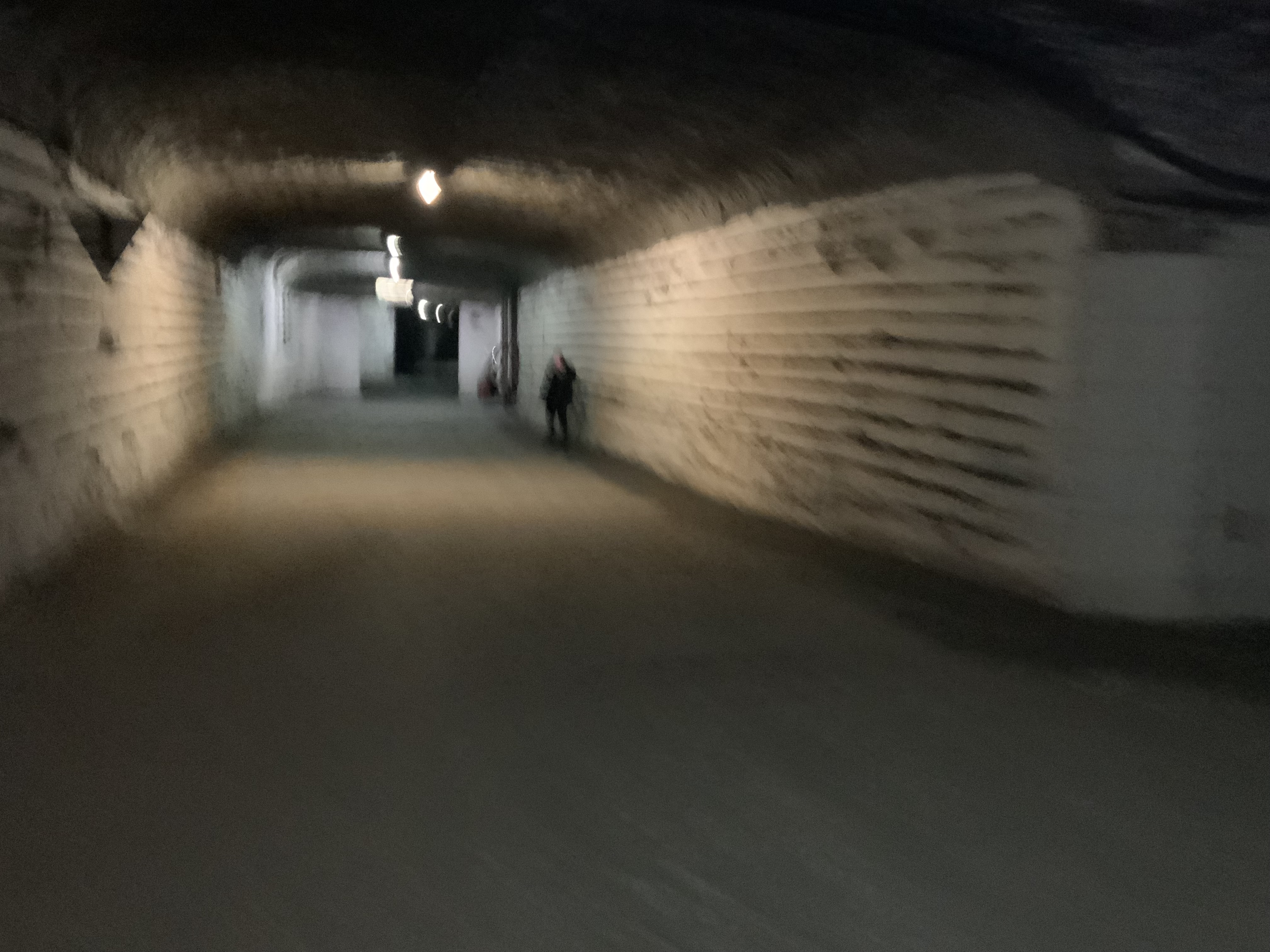

Tunnels.

Our transport picks up quite some speed, and it gets pretty chilly as we whip through the subterranean air. The website warns visitors to bring a warm jacket. I didn't (since I'm jacketless for the entire trip), but I did put on an extra T-shirt under my T-shirt, and this serves me well. Some of my less British tourmates are shivering even in their coats. I think of climate change and the survival potential of living in places like this.


After a while we're brought to a factory, where a production line of serious-looking women are bottling sparkling wine. (Not champagne, since we're not in Champagne, but made using the same method.) When I ask her, our guide informs me that the sparkling-wine-bottlers are invariably women because women are patient and hard-working. I laugh at the implicature about men, but I don't think this goes down well.
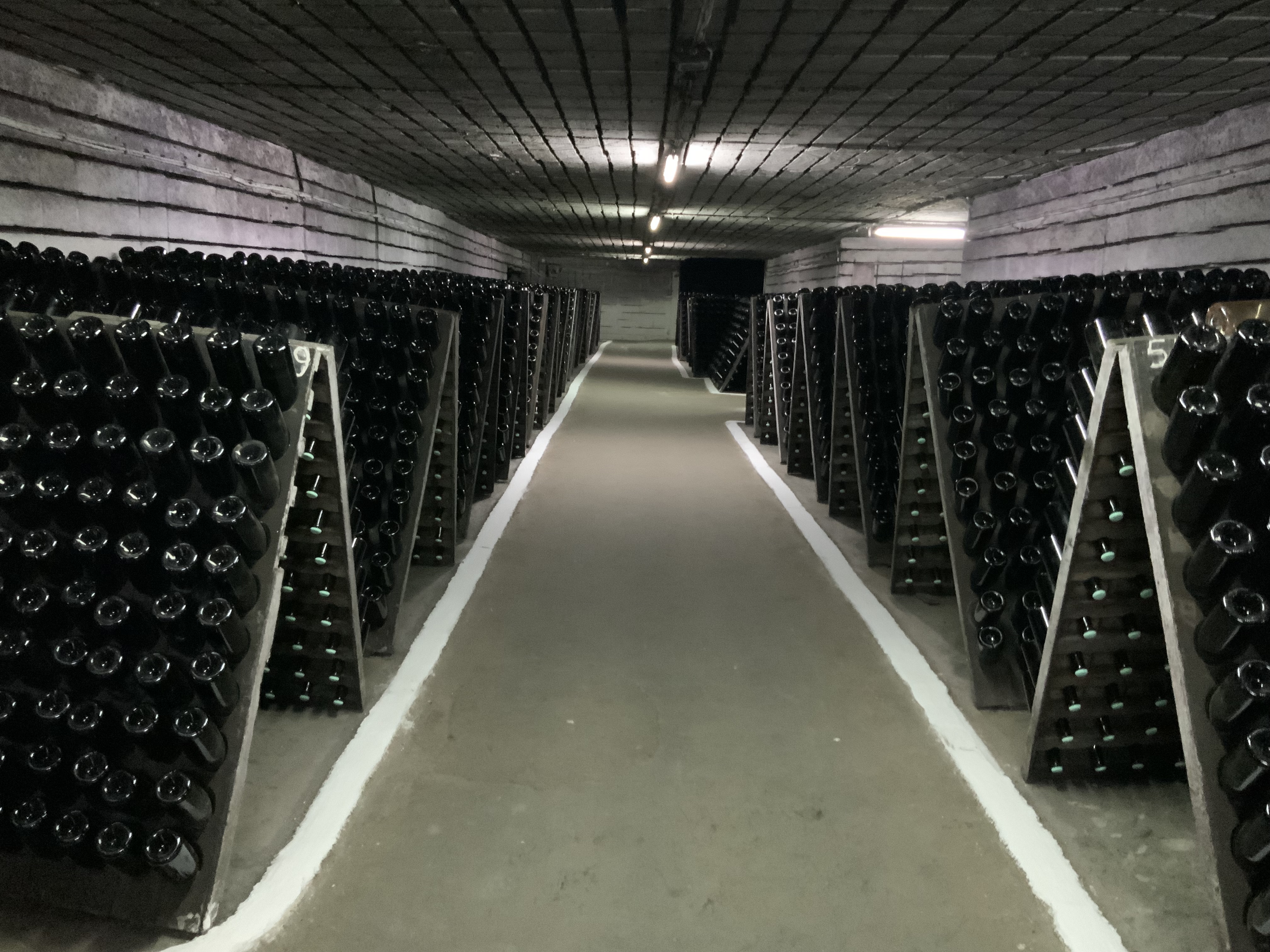

Bottles, all at the appropriate angle.


There's also an underground cinema, where we're treated to a surprisingly philosophical promotional video (what is wine? what is Cricova?). Fortunately, this is accompanied by a very tangible glass of sparkling wine to wash it down. The end of the tour shows us the weirdly palatial underground facilities near the entrance, where the great and the good and many who were neither have assembled to taste the result. From what I can gather, the Cricova winery is one of the jewels in Moldova's crown, and supplied the whole Soviet Union for many years. The first tasting hall is named after Yuri Gagarin, who – he quipped – spent much longer enjoying the wine here than he ever did in space. His portrait hangs by the door.


Gagarin and his letter of thanks.


The tour ends at the gift shop, and we're promised a caddy-bus to transport us back to the entrance, but none materializes. In a rare moment of human self-organization, the group starts walking back to the exit instead. I have my doubts about this – are we even going the right way? – but they are dispelled by the sunlight when we round a corner. Back under the sun, I collect my backpack and trek into the centre of Cricova to get the bus to Chişinǎu. Shockingly, the price for a bus ticket has gone up from the advertized 4.5 lei (about 20p) to a bank-breaking 6 lei (more like 26p). Inspired by my visit, I start thinking about my conversation partner for dinner this evening.

Tuesday, August 20, 2024

Troutworthy's Travel Blog: Old Orhei (With My Feet On The Ground)

Moldova is one of those countries with only one real city. Wikipedia tells me that Bǎlți municipality, the next largest after Chişinǎu, has fewer than 100,000 people, which is barely bigger than Konstanz. This makes it understandable that minibuses – the marshrutkas that are omnipresent in post-Soviet states – are the main means of public transport around here. And indeed, after picking up some lei (Moldovan, not Romanian), my next stop is a marshrutka.


Landscape at Old Orhei.


The first part of my trip takes me out into the country, to Orheiul Vechi ("Old Orhei"). To do that, I need to get a marshrutka from Chişinǎu's massive, confusing central market, which doubles as a central bus station. There's nothing resembling a departures board, and the internet says "ask around", so I do, though this is linguistically tricky: I hear more Slavic around the place than Romanian/Moldovan. After some hand gestures and a friendly man grabbing my rucksack to get my attention, I'm pointed to the marshrutka to Butuceni. This gets quite full, but nothing like the standing-only nightmares I've read about. Shortly after we've left Chişinau proper, the marshrutka stops at a roadside shop, apparently to buy a job lot of glass jars. I don't need to worry about overly anal punctuality here, it seems.


The couple opposite me on the bus are speaking German; probably tourists like me. The urban sprawl soon gives way to rolling hills and deciduous woodland, the same sort I sleepily spotted out of the train window when waking up, but gradually getting hillier. Eventually the marshrutka emerges onto a spur of land with striking views on each side, and rolls down the hill through a tree-lined avenue into the village of Trebujeni.


Old Orhei is situated on a double meander of the river Raut, making for striking limestone cliffs and valleys reminding me a little of my native Peak District. Downstream, the Raut flows into the Dniester, on the other side of which is the rather sad failed breakaway state of Transnistria, but I'm not going there (today, or on this trip). I just head to my guesthouse, where, after an enormous late lunch along with local wine, I repair to my room and conk out. I'm so tired that I sleep straight through dinner and all through the night.


Moldovan lunch.


Vila Roz is named after the roses that fill its enormous garden. The hostess, Liuba, an adorable woman with strong grandmother energy, upbraids me the next morning at breakfast for missing dinner and "going to sleep hungry" – using Google Translate, as she doesn't speak English and I don't speak Romanian or Russian. I apologize and, after another hearty meal, head out to explore the area. It's just gone nine o'clock, but it's already searingly hot, with not a cloud in the sky. I trudge slowly over the hill towards Old Orhei.


The garden at Vila Roz.


We're in the heart of Gimbutas's Old Europe here, and it's fun to imagine pre-Indo-European speakers doing what people do here now: farming, growing grapes, and just generally chilling out. Later it was in Dacia, and never systematically part of the Roman Empire. But the history of Old Orhei really gets interesting with the thirteenth-century Mongol invasions. At this time there arose here a major settlement of the Mongol Golden Horde called Şehr al-Jedid. Mosques, caravanserais, and public baths have survived from this period – the latter just outside Trebujeni on the road leading up the hill. At the top of the hill there's a fort that was built during the slightly later, and much longer-lasting, Kingdom of Moldavia. The touristic centre of Old Orhei is on the other side of this spur of land, where a fourteenth-century Orthodox monastery sits atop another rocky ridge, a network of monastery caves stretching beneath it.


It's still early. With the choice of the archaeological museum or the monastery before me, I decide to walk up to the monastery before it gets even hotter. It's a peaceful, remote place. The caves are even more remote: I tried to reach them, but after some inadvisable scrambling about on a scree slope I decided that my scrambling about on a scree slope was inadvisable and that I should head back to the main path. (Can't say that these guys weren't good at isolationism.)


Old Orhei monastery church.

Down the hill is the sleepy village of Butuceni, where I have a very cheap and tasty lunch of aubergine and meatballs at the only restaurant I can find before following the valley back round to the archaeological museum. This, unfortunately, is disappointing: just one room full of potsherds and bones with terse descriptors ("pot, 14th cent."). Time for the slog back over the hill to Trebujeni, now in the full heat of the afternoon sun. I detour to a promising-looking cafe at the top of the hill for some refreshment, but, despite the opening hours stated both on Google and on its front door, it's closed. Still, there's a viewpoint nearby, so the trek didn't go completely unrewarded.


View over the Butuceni meander from the viewpoint.


Back at Vila Roz, I glug a 1.5-litre bottle of water and prepare myself for some less energetic activities.

Monday, August 19, 2024

Troutworthy's Travel Blog: The Prietenia

Twenty-four more hours of travel. The rest of the journey on the Dacia from Transylvania through to Bucharest passed uneventfully, if scenically. For a while we were stopped at a little rural station in the Carpathian foothills, and youths were hanging out of the open train doors smoking cigarettes – something I remember from my first trip to Romania, fourteen years ago. Between Braşov and Bucharest I was on my own in the compartment. The conductor informed me that we were delayed by an hour, but I laugh in the face of this hour. I have four hours to change trains in Bucharest, and even if that didn't work out, I could hop off at Ploieşti and change trains there, since the Moldova train traverses the same stretch of track north of Bucharest before turning off to the east towards Iaşi and Chişinǎu.


The Moldova train.

But it did work out, and I'm left with three hours to kill in Bucharest. I decide against doing anything touristy, since the station, Gara de Nord, is outside the town centre and I don't want to risk it. Instead I park myself at a coffee shop and indulge in a non-caffeinated beverage, then, when my stomach grumbles, move to the station bistro for a Romanian speciality of chicken with sour cream and polenta. This leaves me plenty of time to buy a couple of pastries before the train to Moldova rolled in.


Gara de Nord isn't dead, like most of the enormous Balkan stations I got to hang about in last year. Its atmosphere is pleasingly vivacious, a riot of colour, with market stalls set up in the main thoroughfare. In the corners and around the edges a shade of grime and sweat has been dutifully if unconsciously applied by the many passers-by. All the shops take card payment; despite the grime, we're unquestionably in the twenty-first century.


Or are we? The arrival of the overnight train to Chişinǎu, the Prietenia ("friendship"), makes me reconsider. It's ancient, maybe antediluvian, an enormous chunky box of a thing. Leaning out of the back door as it reverses into the station is a man in a crisp white shirt waving a little yellow flag. The train is operated by Moldovan railways, and in every compartment window hangs patriotic Moldova branding.


Window drapes.

Inside, the train corridor has disrobed to display various solid-looking metal gizmos. The doors to the next carriage look about six inches thick. They look like they're built to withstand a nuclear blast, I think to myself – and then reflect that, if these coaches were built during the Cold War, that appearance may not be too far from the truth. There are some laminated handouts on a wooden shelf with instructions in Romanian, in Latin script, but all the older signs, embossed metal, are in Cyrillic. There's a toilet, opening directly onto the track, but no shower.


The compartment.


The compartment, which I have to myself, has a glamorous, regal feel to it. On each side is a long bench which doubles as bed, upholstered in patterned burgundy. Above each seat is a mirror, creating an infinite tunnel of light. There is a small Persian rug on the floor, making me embarrassed to be wearing shoes, so I take them off. There's no air conditioning, and with temperatures of 35 degrees outside it's stiflingly hot, causing me to worry about how I will sleep – but the window can be opened, letting in enough fresh air for it to be tolerable. On either side of the door is an old, wire coat hanger, and these jangle against the wall like wind chimes as the train powers north. Outside, the moon dangles in the air like a penny, ready to be inserted into the slot that gives this thing more juice.


Full moon.


This route skirts the Carpathians on their eastern flank. My sleep strategy isn't quite as effective as it was last night; I'd previously thought that turbulence was restricted to aeroplanes but due to my experience with eastern Romanian railways I now know otherwise. The roaring and clattering gets too much at some point, and I close the window, but by this point it's cooled down a lot. Later I'm woken again for passport control (x2, as usual in this part of the world), and I'm vaguely aware of some clanking and creaking as the carriage is switched over from standard to broad gauge, but the next time I'm properly awake is after 7am, when sun is streaming in through the gaps in the curtains. I buy a "country group 2" roaming pack and start munching my börek (breakfast of kings, sadly only found in this part of the world with any regularity). And shortly after that we're in Chişinǎu. I've spent 43 of the past 48 hours on trains, and am looking forward to some time with my feet on the ground.


Chişinǎu station.

Sunday, August 18, 2024

Troutworthy's Travel Blog: Into Transylvania

Those of you who've been following my exploits closely know that I am a completionist and like setting myself silly tasks. Probably the biggest is my current mission, for which the clock is ticking: to visit all the countries of Europe before my fortieth birthday. And that's where this trip fits in.


Archita with its Saxon fortified church, seen from the train.

Only five countries remain. Three of those are not an option right now, for war-related reasons: Belarus, Ukraine, Russia. That leaves two: Cyprus – which I still might fit in before time runs out, though it's tricky without flying – and Moldova. Which is where I'm heading now, for a few days of summer relaxation.


To get to Moldova from Konstanz, you only need to change trains twice – the same as if you're going to London, or indeed many places around Stuttgart. The difference is that this trip takes forty-eight hours. The crucial first step is a somewhat unexpected one: get a local bus to Allmannsdorf and then a slightly-less-local bus across the lake to the small industrial town of Friedrichshafen. This bus goes onto a boat; the trip will be nothing if not multimodal. From there follows a somewhat implausible direct train to Vienna, which takes all day. With any luck I'll be in time to catch the sleeper to Bucharest, and from there another sleeper to Chisinau. Only two changes.


It's cool and crisp the morning I set off, perhaps the first truly chilly morning we've had all sweltering summer. I don't love boats at the moment, but I do hop off the bus in order to take in the lake breeze and survey the surroundings. Compared to this – confirmed holiday destination Lake Constance – Moldova is an unknown, a country I'd perhaps never have thought to visit if it wasn't for my completionist scheming.


I've splurged on business class for the nearly eight-hour Railjet to Vienna. It's snazzy, with big, reclinable black leather seats, waiter service, and a little reading light. Even here I can't avoid crying children or the small clique of Austrian men whose opinions everyone in the carriage Must Hear. But they fade into the background as the train makes the ascent from Feldkirch up the valley to the Arlberg.


Do you deserve this? Do I? Does anyone?

The Arlberg railway is a contradiction, simultaneously a quaint, scenic mountain line and one of Europe's trunk routes. The stretch between Bludenz and Innsbruck is a treat, and I spend much of my time staring out of the window. The highlight is the quintessentially European Trisanna bridge, over a high mountain gorge with a castle at the end of it.


After Wörgl, the train passes back into southern Bavaria for the stretch to Salzburg, and the terrain oscillates between rolling hills and plains, with the latter predominating as we approach Vienna. I stocked up on non-perishable snacks at Friedrichshafen for the sleeper portion of the trip, and don't have much time in this city (magnificent though it is in its own right), but it's enough to sit and have a lasagne and a glass of red wine at a generic Italian restaurant at the station.


Next leg of the trip is the venerable Dacia sleeper from Vienna to Bucharest, one of Europe's longest and slowest. I'm in a 3-bed sleeper compartment with a Romanian man; a Chinese man joins us at Budapest, near midnight. The compartment is basic but functional and mercifully cool. I pop an over-the-counter sleeping pill (top tip for these journeys!) and fall asleep to the smell of burning brake pads. The Hungarian and Romanian border controls in the early hours, and my Romanian friend getting out somewhere, wake me only briefly, and I get at least a semi-decent 8 hours' sleep.


Romanian Dacia sleeper car arriving in Vienna.


When I wake up in the morning the train has started to rise into the Transylvanian Carpathians. This is one great advantage of the Dacia: we don't get in until mid-afternoon, but the most beautiful part of the journey is during the day. As the train passes Sighisoara, I head down to the bar car, which has nice big windows and is well stocked with everything you need for a healthy diet.


The bar.

We pass Archita, a beautifully bucolic Transylvanian Saxon village, as I sip my instant coffee and munch on yesterday's Butterbrezel. At every station we pass, the stationmaster stands to attention in his cool hat. I really must revisit this part of the world some time soon. The train is crawling along, and on a long curve I can see that that's because we're behind a freight train. A map of European train speeds I found on Reddit tells me that the journey gets slower and slower as we head east: from an average of 141.6 km/h (Germany) to 106.8 (Austria), dropping down to 83.7 (Hungary), then 72.9 (Romania), and ultimately into the dreaded No Data (Moldova). Is Zeno's paradox about to kick in, preventing me from reaching my goal? Time will tell; but so far so good.

Monday, July 29, 2024

Konstanz Working Cafés #15: Kaffee Blende 8

Despite notionally being on research leave, I haven't been able to pursue my Monday café habit for a while. But here's a new one: Kaffee Blende 8.

Sunny courtyard.

This place hasn't been here for long. It's attached to the Leica gallery, which is some sort of paradise for camera hipsters. Advantages:
  • Location. Very close to Sternenplatz bus stop, and not far from the city centre, near No. 11.
  • Ambience. If you're not turned off by the black-and-white photos of photography hipsterness, this place is great. There's a lovely courtyard (pictured) where you can sit outside, in the sun or the shade. The inside is a thick-walled, high-ceilinged old building that's perfect for staying cool in the unpleasantly muggy Konstanz summer. Cooling drinks are available too...
An iced latte.
  • Wifi. The place has its own wifi! It just works!
  • Prices. Given the hipster vibes, I'd have expected more tbh.
  • (Torn. As I was writing this, Torn by Natalie Imbruglia came on, which is a banger.)
Disadvantages:
  • No savoury food. Only matters for work if you're long-hauling it, though.
  • Inattentive service. Despite at least three people serving, it took ages for any of them to notice me, and the place wasn't even particularly busy.
  • Few power sockets. You'd have to get very lucky with your table.
Price of a regular black coffee: €2.50 small, €3.50 large.

Overall rating: ☕️☕️☕️☕️ (something like 4.3/5).

Thursday, April 04, 2024

Troutworthy's Travel Blog: Up and round

I leave Helsinki on the evening of the second, boarding a train that is bound for Kolari, in the far north. Kolari itself is the northernmost tip of the Finnish passenger rail network, but I'm not going that far: Tornio, on the estuary of the river Torne – the river that defines the Swedish-Finnish border for hundreds of kilometers – is my destination. Still, it's the furthest north I've ever been in my life, narrowly beating out Akureyri, in Iceland.

The Finnish night trains are well equipped. Like other countries of the former Russian Empire, Finland's railways are built to five-foot gauge, which allows these trains to be enormous beasts of burden. I'm in a two-bunk compartment on the lower level, effectively meaning that four people can sleep stacked vertically. The trains are new and very clean, with card-locked compartment doors. I don't sleep very well, perhaps because it's odd to be travelling so far north when I'll be turning round and heading south again the next day.

Tornio doesn't have much of a station – just a platform with a couple of signs on it. When I arrive, the sun is shining, but it's icicles-in-the-beard temperature. In principle, a branch to the southwest means that trains can travel between Tornio and its adjacent Swedish twin city, Haparanda, on the other side of the Torne, albeit with a break of gauge. In practice, no passenger trains currently make the trip, and so it's a trek of a little under five kilometers to Haparanda station.

The frozen river Torne.

This part of Tornio is pretty industrial, and the black ice on roads and pavements is treacherous, but I manage to find my way through via a surprisingly nice little bakery and café. A long bridge connects Tornio island – where the heart of the town is – with the industrial side, but it's not even necessary: the river is completely frozen over, and that doesn't look likely to change any time soon. With the morning sun reflecting off the white expanse of the Torne, it's dazzling.

A smaller bridge crosses the channel from Tornio island to Haparanda. It's blue and white on one side, and blue and yellow on the other. I'm back in Sweden. Some slipping and sliding later and I'm at Haparanda station.

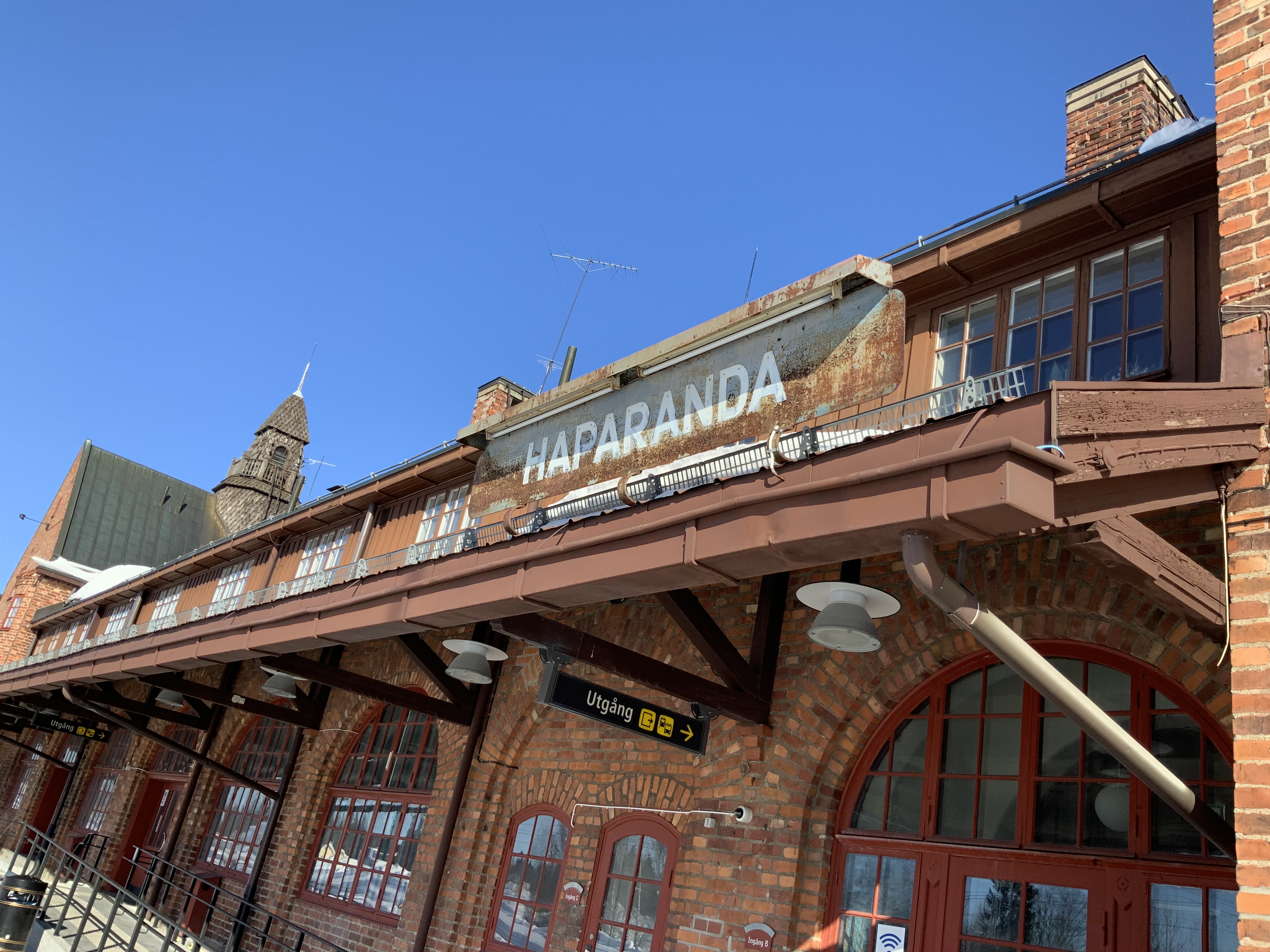
Haparanda station from the platform.

This enormous building is rather ghostly. It is open and (mercifully) heated, but there's no one around. The ghostliness is accentuated by artistically-placed piles of early-twentieth-century luggage. Apparently the border here saw many refugees pass through during the wars. The station was recently and grandiosely renovated using EU money, but doesn't seem to see much use: there's a space for a café, but no café (alas). It's de facto the end of the line, and there are only two trains a day. I check my watch: the next one isn't for four hours. I remember that I've entered a new time zone, change the time on my watch, and check it again. Five hours.

Spectral luggage.

“One-horse town” would be an overstatement for Haparanda. (The Western allusion is appropriate, though: the whole area feels very frontier, the Wild North.) I head into town and find a simple restaurant offering a nice buffet with fresh catch. Although it's modern, the vaulted ceiling and long lines of tables put me in mind of a mead-hall of legend. Perhaps I've been reading too much Kalevala.

In the end, the train is replaced by a bus, a fact about which no one seems very surprised. Two hours later and I'm in the northern Swedish railway-junction town of Boden, for which “one-horse town” is a thoroughly appropriate descriptor. Along comes the corrugated-metal night train and I hop on, finding it hard to believe I'll wake up in Stockholm. Compared to the Finnish sleeper, this one is somewhat dated, but I'm in an ensuite, and it's beautifully spacious. (Probably because they put me in a wheelchair-friendly compartment, with alarm buttons everywhere.) 

Swedish sleeper compartment.

After this chilly, adventurous day I sleep the sleep of the righteous in the comfy train, and in the morning I change onto the fast train to Copenhagen, from where I will continue south. None of this was actually part of the plan! But improvisation is fun, when you can afford it.

Here's the outline of the trip so far. This'll probably be my last post from this holiday, since I'll be working on the train tomorrow. Thanks for reading!


Tuesday, April 02, 2024

Troutworthy's Travel Blog: Helsinki

March, and the Easter weekend in particular, isn't the best time to visit Helsinki. Lots of things are under (re)construction – the Sibelius park, the Havis Amanda statue – and other things, like the Seurasaari open air museum, are closed. The occasion for my visit was a gig by Mew, one of the best bands in the world, performing with the Danish Chamber Orchestra, but this too is a bust: they cancelled at short notice. Still, the day I arrive in Helsinki, the sun is shining.

Suomenlinna fortress in the sun.

Devoid of any grand plan, but with a few tips from friends to work with, I roam. The Temppeliaukio church, carved into the rock, is a sublime piece of modern architecture. Nearby, the Arkadia bookshop is well-and-truly lose-yourself-in-able.

Temppeliaukio Church.

Karelian rice pies are not in short supply.

Karelian pies in a hipster café.

Snow still gathers in clumps in the shade here, unlike in Stockholm, and much of the bay is frozen over. With the Sibelius park denied to me, I get a cinnamon bun and coffee at Café Regatta and gawk out over the ice. Later, wandering round town, hopping on and off ancient trams, I do some more gawking at the fine Art Nouveau buildings that seem to be on every corner. The Oodi central library is a bit of a monstrosity from the outside, but on the inside is a fine civic building, a library for the twenty-first century. At the Kiasma contemporary art gallery just round the corner, I'm surprised to see that one of the artists who's being exhibited is Simon Fujiwara, who's featured on this blog before.

On my second and third days in Helsinki, the weather turns cold and grey, and on the afternoon of the fourth it starts to rain quite heavily. This is fine; I'd probably have felt short-changed if I'd visited a Baltic city and there hadn't been at least one day like this. But four days is not enough for Helsinki, and I hope to come back here one day.

Monday, April 01, 2024

Troutworthy's Travel Blog: The Party Boat

The party boat.

Stockholm was in many ways as I remembered it – though, as I realized with a shock, it's been nearly twelve years since my previous visit, and even that was for a conference with little time for sightseeing. This time I found myself at the Hagaparken to the north of the centre. Most of the winter ice is gone, though a cold wind still blows. We stopped for coffee at a mysterious copper tent.

The next day, after some more wandering, we visited the Vasa museum. Not the titular “party boat” of this post, it's a seventeenth-century ship which immediately capsized in Stockholm harbour on its maiden voyage and was preserved in the city's historically-minded Baltic waters. The museum too was as I'd remembered it from my first visit, perhaps unsurprisingly. It's huge, dark and austere and a handy reminder of human hubris and folly. The academics and conservationists now labouring to preserve it seem almost monomaniacal: the constant visits from humans, we are told, take their inevitable toll on the ship's integrity, but they are working to make sure it lasts forever. Perhaps, when the apocalypse has passed and a future race of extraterrestrials stumbles upon the shattered remnants of our sorry planet, the preserved Vasa will still be there to teach its lesson to these new visitors. “Look on my Works, ye Aliens, and despair!” Or perhaps, more likely, it'll be a second-order failure.

The Vasa.

In the afternoon, we boarded the ship to Helsinki.

I must confess to having had the wrong expectations of this journey. For me it was a fairly sober and straightforward way of getting from A to B, and, from my knowledge of the inhabitants of the area, I expected the voyage to be dull, more than anything else. Turns out I didn't know the inhabitants of the area as well as I thought.

My associate sagely described the experience as a cross between Dubai duty free and a Barnsley Travelodge, and it's an apt comparison. Outwardly all is calm, at least for a while: for the first four hours, as the sun slowly sets, the Silja Serenade traverses the Stockholm archipelago, hitching up its skirts to navigate the narrow channels. It's tranquil and beautiful.

Dancing with another passing titan.

Inside, Ragnarok is here. In the time we've been out on deck, the Swedes and Finns have wasted no time, and have already put several away. Children spin each other around on rotating seats as their parents swill lager. On the stage of the Starlight Lounge, a cover “band” mimes along to various 80s classics; when Abba comes on, everyone goes apeshit. And down at the sixth circle of hell – sorry, deck – our Nordic heroes are fortifying themselves with as many twelve-packs and two-litre bottles of whiskey as they can carry. One can see why the Man in Seat 61 describes these voyages as having “a reputation as party boats”.

Bright lights, big boat.

At around midnight we're due to dock at Mariehamn, in the Åland islands. The ship slows down and stops, but the party doesn't. From here it's nearly ten hours across the open sea until we reach our destination, so I retreat to my cabin. The less said about the rest of the journey, the better; suffice it to say that I'm not much more of a fan of boats than I am of flying, and even with the partygoers well out of earshot there's plenty to occupy my mind.

We shuffle off the boat punctually in the morning. On the bright Helsinki harbourside, a group of youths with nothing in the way of luggage lurch endearingly along, likely readying themselves to do the whole thing again in reverse in the afternoon. All power to them.

Thursday, March 28, 2024

Troutworthy's Travel Blog: Heading north for Easter

The sleeper train from Hamburg to Stockholm has only been running since 2022 – part of the new wave of sleepers that have been popping up around Europe since the dark days of the mid-2010s. The nadir was 2014–16, when Germany's Deutsche Bahn got out of the sleeper business entirely. But, aided by a heavy dose of shame, they're making a comeback, especially in Scandinavia.

And so I'm on one, and will be in Stockholm within the hour. That's about 1300km north from Konstanz, which isn't bad for just over 24 hours, the first four of which were spent trundling across the Schwäbische Alb. It hasn't all been plain sailing: the ICE to Hamburg ended up 45 minutes late, and the sleeper set off from Hamburg-Harburg rather than the city centre due to engineering works. At this point the sleeper is over an hour delayed, though in my experience that's not at all out of the ordinary for night trains (unfortunately).

Photo of birch forest out of train window
A representative vista in southern Sweden

The sleeper compartments are narrow, but the beds surprisingly comfortable. The train seems to be completely booked up; my compartment-mate tells me that there's far more demand than supply. Breakfast is a fresh bread roll with some butter, cream cheese and jam; the coffee is less shit than I'm used to on trains. Now that I've woken up, southern Sweden rolls by unremarkably, mostly birch or pine forests on level ground punctuated by serene patches of water. The sun is shining.

Thursday, January 25, 2024

Konstanz Working Cafés #14: Backhaus Mahl

A new contender, in the brand new building off Sternenplatz. I don’t normally include bakeries in this series, but this one is unusual, as you’ll see!

Fake plants
Fake plants

Advantages:

  • Location. Right next to Sternenplatz bus stop, just outside the city centre. Easy to reach by foot or by bus.
  • Wifi and power sockets, the latter at pretty much every table. Amazing!
  • Food. Nothing fancy, but alongside the usual bakery fare of filled rolls and cake there are some very nice hearty brunch-style options, including omelettes and salads.
  • Spacious. There’s a deceptively large seating area at the back.
  • Open every day. Even Sundays!
  • Cheap and cheerful. Omelette and coffee for €8.05.
Disadvantages:
  • Ambience. Clean and bright, but unlovely, I’d say.
  • Kids. It's right opposite a secondary school, and at certain times of day it is full of teenagers.
Coffee here is decent, though nothing to write home about.

Price of a regular black coffee: €2.90 for a generous “normal”, with a small option for €2.

Overall rating: ☕️☕️☕️☕️☕️ (5/5). I’ll be back!