Sunday, May 22, 2011

Choose the new Chancellor of the University of Cambridge!

This is an important one! If you have a Cambridge masters degree or higher, or know someone who does, be sure to read on.

According to an inconspicuous notice posted outside the Senate House, backed up by this link, Lord Sainsbury has been nominated to serve as the new Chancellor of the University of Cambridge (its honorary top man, in other words). Presumably this is because our beloved Prince Philip is getting on a bit, and it'd be embarrassing to have him die on the job. More interesting, however, is the following:

"This nomination is now before the University's Senate for approval. Fifty members of the Senate may nominate an alternative candidate."

What exactly is the Senate, then? When I looked into this I was surprised to find that it's us, or at least those of us in possession of the rather silly Cambridge MA or another masters degree or doctorate. Yes, that's right: if fifty of us can get together by 17th June to nominate an alternative candidate, there will, as I understand it, be an actual election to determine the new Chancellor.

Now obviously for practical purposes it doesn't matter a jot who's the Chancellor; it's not as if Prince Philip actually does anything in the role, despite the website's insistence that he has "important statutory duties". But the selection of billionaire David, Lord Sainsbury of Turville, sends a clear political message: by choosing a lifelong money-man and politician, who joined the family firm after failing to get the grades to become a scientist, the University would be aligning itself with government and industry, and with the 'new market', rather than with the interests of its constituents in education and academia. Through his Gatsby Charitable Foundation, Sainsbury (former chairman of Sainsbury's) has donated vast amounts of money to various causes. And he seems to be a nicer guy than his dictatorial cousin JD Sainsbury. But his appointment would be a statement to the effect that a culture of philanthropy, where the super-rich give to the poor, is a sustainable and appropriate model for higher education funding. It isn't. As Jeremy Prynne puts it (in the context of a slightly different cause),
All aspects considered, it seems to me now a critical moment to raise a voice, along with Oxford, against this constantly sliding and destructive tendency degrading a coherent policy for Higher Education; university funding cuts, massively increased student fees, major invasion of university self-government (admission policies, etc), together with the ever more proclaimed ‘market model’ for the whole sector. Are we also to end up with a new market-style Chancellor? These things are massively confused and massively wrong, and in default of any more intelligent and joined-up planning they are current government policy.
So an alternative candidate is needed, one who sends the opposite message. Moreover, it would be relatively easy to nominate such a candidate. The question is: who should it be? As I see it, it should be a public figure who's shown support for the general principles of the Defend Education campaign, and in particular opposes the marketization of higher education and research. Any ideas?

Wednesday, May 18, 2011

Ritter Sport ratings - the state of the art

New varieties. Even though I was in Germany for less than a day, I still managed to pick up four new flavours, all for the sake of you, my beloved readership. Brief notes this time.

Alpine Cream & Praline: 6.5/10
Another fairly unremarkable creamy variety, with a hint of crunchiness. It went down easily enough.

Bourbon & Vanilla: 7.5/10
As liqueur varieties go, this one is great - the vanilla is genuinely flavoursome and not too sweet.

Hazelnut & Almond Crumble: 6.5/10
Crunchier than the first one, but otherwise mostly indistinguishable. A bit too sweet, as I recall.

Corn Flakes & White Chocolate: 8.5/10
Really good! The extreme crunchiness works well for me, especially with the white chocolate which can otherwise be a bit cloying.

So for reference, the overall ratings at this stage are:

Rhubarb, strawberry and yoghurt: 9/10
Milk Chocolate: 9/10
Alpine Milk Chocolate: 9/10
Crunchy Biscuit (Knusperkeks): 9/10
Caramel & Nut: 9/10
Corn Flakes & White Chocolate: 7.5/10
Nougat: 8/10
Cappucino: 8/10
Hazelnut (milk chocolate): 8/10
Hazelnut (dark chocolate): 8/10
Fine Dark Chocolate (Edel-Bitter): 8/10
Rum, Raisin & Nut: 8/10
Orange & Marzipan: 8/10
Fruits of the Forest & Yoghurt: 7.5/10
Peach & Passionfruit: 7.5/10
Bourbon & Vanilla: 7.5/10
Marzipan: 7/10
Blood Orange: 7/10
Raisin & Nut: 7/10
Coconut Batida Liqueur Truffle: 7/10
Vanilla Liqueur Truffle: 7/10
Knusperflakes (Crunchy Flakes): 7/10
Stracciatella: 7/10
Vanilla Cookie: 7/10
Milk & White Chocolate: 6.5/10
Alpine Cream & Praline: 6.5/10
Hazelnut & Almond Crumble: 6.5/10
Sunny Crisp (sunflower seeds): 6/10
Espresso Crunch: 6/10
Half Dark Chocolate: 6/10
Marc de Champagne Truffle: 6/10
Amaretto Truffle: 6/10
Whole Peanut: 6/10
Hazelnut (white chocolate): 6/10
Raisin & Cashew: 6/10
Nut in Nougat Cream: 5.5/10
Dark chocolate with Creme a la chocolate mousse: 5/10
Jamaica Rum: 5/10
Kakaocreme (Cocoa cream?): 5/10
Peppermint: 5/10
Whole Almond: 4/10
Golden Peanut: 4/10
Yoghurt: 4/10
Lemon: 3/10
Egg Liqueur Truffle: 3/10
Coconut: 2/10
Diet Half Dark Chocolate: 1/10

Sunday, May 08, 2011

On the Big Society

My sole remaining grandparent is 89 years old. Her husband has been dead for nearly a decade. She's entirely blind in one eye and half-blind in the other, is unable to hear without a hearing-aid, has skin as thin as tissue paper, suffers from crippling arthritis and cannot walk unaided. She hasa special alarm buzzer to press if she falls, which happens frequently. Yet she's generous, and happy (helped by large quantities of morphine), and upstairs she's sharp as a tack.

For the last 8 or 9 years she's had regular visits from the social services to help her with various things, in particular the preparation of meals, since she's very shaky. Earlier this year she suffered a bad fall, dislocating her hip. For a few weeks they moved her from hospital to hospital, and for six weeks after that they helped her rehabilitate to life on her own again.

Now she's been told that they've reassessed her situation and determined that she doesn't need help from the social services, and that they therefore won't be supporting her at all any more. When this decision was questioned by one of my aunts, she was patronizingly told that my grandmother should try to look for some randomer in the village to look after her. Because of course looking after old people requires no skill or training at all.

There's more to it than her situation changing, of course; old people don't suddenly recover from arthritis and regain their hearing and sight. As far as I can tell, this development is a direct consequence of the Carers Strategy, a recent government initiative, which contains such gems of euphemistic Tory bullshittery as 'Our Big Society reforms will see public services opened to challenge'. More worrying in these documents is the complete lack of any distinction drawn between trained professional carers and those who have no training and carry out the role through necessity. But of course the Big Society is all about people with no training taking on roles at which they will epically fail.

Philip Pullman has put it better than I could with respect to the similar situation facing librarians: 'Does [the government] think the job of a librarian is so simple, so empty of content, that anyone can step up and do it for a thank-you and a cup of tea? Does he think that all a librarian does is to tidy the shelves?' Pullman is 100% right, and his point is an important one even if you don't personally care about libraries, if only to forestall the chilling reductio ad absurdum that our beloved coalition government is currently pursuing. To put it bluntly: few people are going to die because of a lack of trained librarians. With carers, on the other hand...

And soon the NHS is going to be 'liberated', as well. Apparently this new approach 'puts people in the driving seat' - what, as opposed to the monkeys/robots/nodding dogs/aliens/vampires/cheese graters that were there before? This isn't just empty rhetoric; it's empty rhetoric that will kill thousands of people. Please sign the petition to save the NHS if you haven't already.

As for me, I'm tired of trying to phrase my criticisms of this government's abhorrent disregard for society in a witty, urbane, disinterested way. FUCK YOU, David Cameron, you ignorant, slimy, self-satisfied rich kid. FUCK YOU, Conservatives. And to anyone who reads this and voted Tory in the last election: I hope you're fucking ashamed of yourself. You've helped to elect a government that's tearing down our society brick by brick, and putting our country on the road to self-disintegration.

Friday, April 01, 2011

I love my life as a Linguist (a gentle autobiographical sketch)

Got on the train from Derbyshire
Moooved down to a Cambridge home
Got a moustache and an ill-kept beard
Some research papers and a syntax tome
Marking work with a ballpoint pen
There is just one thing in my FLN
I like Merge
We all like Merge

Teaching Middle English for an insufficient fee
Acting like a prof although I have no PhD
I remember when the kids at school would laugh at me
Now I'm analysing their CP
woah o o...

(chorus)
I love my life as a Linguist
All my friends are Linguists too
Come with me let's be Linguists
Haven't you heard? Being a Linguist's cool
Being a Linguist's cool
Being a Linguist's cool cool cooool

CorpusSearch app on my laptop
Running queries on Old Norse prose
Present the results at a workshop
Yawning faces in ordered rows
Coolest kids at the training day
Attendance list, look there's my name
I turned up
You didn't turn up

Never take a plastic bag, I always use my own
Plugging in my laptop at the library down the road
Say I'm getting funding but it's really pretty low
I'm the coolest guy you'll ever know
woah o o...

(chorus)
I love my life as a Linguist
All my friends are Linguists too
Come with me let's be Linguists
Haven't you heard? Being a Linguist's cool
Being a Linguist's cool
Being a Linguist's cool cool cooool

Ale with pub ice cream
Cartography meets DM vP
Indeterminate theoretical preference
Something retro in my analysis

"Basically I'm a part-time webmaster; I also help design a magazine where all the articles are in different languages."

"I go to syntax pub nights."

"Er, yeah, I once stage-managed a Shakespeare play in a converted bread-oven in Switzerland?"

If that lot doesn't make me a dickhead (in the traditional sense of the word), I don't know what would. Apologies to TheGrandSpectacular, whose original version is superior in every way.

Thursday, December 09, 2010

Return of the Ritter Sport ratings

Ah, it's a great excuse to go to Germany at least twice a year. Ritter religiously bring out summer and winter varieties; so here they are, in all their glory. (The summer varieties, along with another three new ones, were evaluated while I was on my way back from Romania, and I transcribe here from my travel journal; the three winter varieties were sampled when I was in Berlin giving a talk.)

Raisin & Cashew: 6/10
Given my current cashew-nut obsession, it pains me to give this one a low-ish mark. The problem's not that there's anything wrong with it - just that it pales in comparison to what it could have been. Ritter have gone for a fairly traditional fruit & nut combo, which goes down easily enough; too easily, really. Cashews aren't the crunchiest of nut, and here they're chopped extremely finely, with the risk that they are overwhelmed entirely by the fairly rich Ritter milk chocolate and raisins in some mouthfuls. I'd have preferred larger chunks and, for that mater, a more adventurous recipe: cashews and caramel, for example, or cashews and some sort of liqueur/liquor. Still, this one was a pleasant enough eating experience and left a fine taste in the back of my mouth. Never going to be a favourite, but this was definitely worth a try.

Caramel & Nut: 9/10
My goodness, Ritter, you really can pull it off. This one was magnificent - the flavours and textures of the standard milk chocolate, the dry caramel and the crispy nuts all blend together like magic upon contact with your tongue. It's a long time since I did the bulk of the ratings, but I'd be hard pressed to say that this isn't the best variety I've ever tasted. Then again, I have been subsisting on dried bread and cashew nuts for the last few days. Whatever the case, this is a top-class variety that I couldn't bring myself to take my time over. Not too sweet - a bit salty.

Milk & White Chocolate: 6.5/10
I expected this one to taste like a Kinder egg, and for once with a Ritter Sport I got exactly what I was expecting. Very sweet and cloying; dark mixed with white would have produced a more interesting contrast, even visually, and the look of this one from above is its biggest selling point. Problem is, I'm just not that much of a fan of white chocolate given the choice. Oh well - at least it doesn't kill me like it does David. Overall, not terrible, but nor is it a real pleasure to eat like so many other varieties.

Stracciatella: 7/10
As a massive stracciatella ice cream fan I couldn't turn this one down - it's one of their three summer varieties for 2010. They've done a good job of recreating the refreshing taste, but it didn't quite have the bite of the ice cream version, of course. The contrast between dark and light, between the freezing, melting cream and the rich, unyielding shards of chocolate, just can't be translated. The vanilla cream eventually becomes tiresome, too. Yet for all that, it's worth it just to get the initial shock of recognition. A success, even if not destined to take off as a chocolate variety.

Fruits of the Forest & Yoghurt: 7.5/10
Ate this one while wandering around the grounds of Osborne House, Queen Victoria's favourite house. Very acidic, flavoursome fruit filling, and the yoghurt is well done, although I've long since forgiven Ritter for having a yoghurt filling that doesn't taste like yoghurt, since it's basically impossible. The fruit goes well with the chocolate; dark chocolate may have made this one even better, though, just for the contrast factor. That thought prevents me from giving this a top rating, but it scores highly nonetheless.

Peach & Passionfruit: 7.5/10
Coated in white chocolate and with a crunch that presumably has nothing to do with peach or passionfruit, this was a surprisingly enjoyable eat. The fruity flavours were sharp enough to offset the more mellow sweetness of the white chocolate, and the passionfruit was very genuine and dominant (called 'Maracuja' in German). Not really a complaint to be made against this variety; it's not my favourite of flavours, but the execution of the concept is perfect.

Orange & Marzipan: 8/10
Not 'delicious', but close enough to warrant an 8. Certainly there's not much to criticise in this intriguing balance of flavours: the sharp, insubstantial orange flavour contrasts deliciously with the weightier taste (and texture) of the marzipan. Oops, did I say 'deliciously'? I meant 'almost-deliciously'. In this battle of the big hitters it's the chocolate that loses out, if anything, but its creamy texture still provides the frame for the whole experience.

Nut in Nougat Cream: 5.5/10
Boring. I feel like I've eaten this one before. Not bad, just boring.

Vanilla Cookie: 7/10
Tasty. Crunchy bits of cookie with a vanilla flavour in milk chocolate. Went down a treat - the pieces of cookie were large enough to give one pause for thought, so texturally a success as well as in terms of taste. Perhaps not a particularly adventurous variety, but it beats all those variants with different types of nut in them, and I certainly wasn't expecting it. Bring back the legendary Baileys flavour or the Smarties, though - the possibilities are endless!

Monday, October 18, 2010

Another thing that's beneficial to society despite being inherently unprofitable

I'm talking about education, innit?

Lest anyone get the wrong idea: we've been here before. The Browne Review recommends cutting public funding for university teaching by 80%. That sounds remarkably similar to the 1982 Serpell Report mentioned in my post of last year, which would have cut UK rail network mileage by 84%. Both reports were motivated by the same concern: the desire to make a publicly-funded entity economically self-sustaining.

Perhaps the similarity ends there. Sir David Serpell was a well-respected senior civil servant, tasked by his government to find a stupid answer to a stupid question. As a relative of his, Nick Serpell, pointed out on my blog, I shouldn't have given the impression in my last post that the report represented Serpell's own opinion. I'm sorry I did so.

Lest it be said that I shy away from ad hominem attacks, though, let's talk about Browne. A member of an institution well known for its transparency and accountability, the House of Lords, Browne is a distinctly oily figure - even putting aside the fact that he used to be Chief Executive of BP. This is a man who has admitted to lying in court. He's never had any serious involvement in academia himself - in fact, it's even been speculated that one of his motivations in proposing cuts may be to get back at the Cambridge establishment for being slighted by one of his professors during his own university days. He's also been accused of making fierce cuts during his time at the helm of BP - although that's in the Daily Mail, so should be taken with a pinch of salt. In any case, it's clear that this isn't the sort of man we'd expect to be appointed to chair an impartial review of spending on academia; unless, of course, the outcome was essentially predetermined, the game rigged.

Various people have pointed out, not particularly perspicuously, that the way UK universities currently fund themselves is not economically self-sustaining. As I've argued in my previous post, however, to argue that everything can, and should, be profitable reveals a serious misunderstanding of how human society works. The question that Browne (like Serpell) was tasked with answering isn't even one that it makes sense to ask. Education (like the rail network) isn't profitable, and shouldn't need to be. Funding it publicly shows that we're better than animals: we can actively choose to improve the way the world works, to make sacrifices for the greater good, rather than engage in a narrow-minded orgy of self-interest as the capitalism apparently espoused by the last two governments would have us do, blindly trusting/hoping that the invisible hand will level it all out. But that's enough naively idealistic vitriol.

Jessica pointed out in a comment on (the Facebook version of) my previous post the value of education. I didn't give it much thought at the time. Now, of course, I am doing, for the simple reason that it threatens something I hold very dear indeed: the availability of education, and the pursuit of broadening the sum of human knowledge. I should point out that I'm not personally threatened: I have funding for the rest of my PhD, and when that's over I should have the qualifications to do pretty much anything I want short of becoming an astronaut or brain surgeon. But future generations will have to bear the brunt of this - which is another reason I think the proposed cuts are abhorrent. Future generations suffer from the notable disadvantage of not being able to defend themselves: they can't vote, and they're mostly very small if alive at all. In fact, why doesn't Browne just cut out the middleman and set about punching babies of poor families in the face? It would have the same net effect. (Incidentally, the same argument applies to global warming deniers and other such head-in-sand-buriers; passing on a problem to the next generation while ignoring it and allowing it to grow in the meantime is Not Ka-Blamo!)

Nor does pointing to America provide a solution. American universities are largely able to stay afloat and provide scholarships, insofar as they can, because of a culture of philanthropy on the part of those who have struck it rich in the real world. Such an attitude is totally alien to the UK, and I find it hard to believe that the situation would change suddenly if fees were increased and public spending slashed. The American model isn't going to be transferred over here overnight. It would take time, and, as is well known, time is money. Money is something British universities will lack if Browne's proposals go through; by the time the "philanthropic mindset" sets in, if it does so at all, many smaller departments and institutions will have sunk without a trace.

Oh, and of course in the above I've taken it as given that broadening the sum of human knowledge is a good thing. Please don't disagree with me on that, as it would make me sad.

There's a demonstration on 10th November. If you agree with any part of the above*, I'd strongly encourage you to attend. It's hard to imagine an issue with more potential impact on the way our society currently works.

*Except the part about punching babies. Again, Not Ka-Blamo.

Friday, October 02, 2009

WOOD

Another look at the blockbuster show that's currently taking the US by storm.

ABC's new hit drama, WOOD, is a live-action remake of the classic British animated series Animals of Farthing Wood, based on the novels by Colin Dann. A plucky ensemble cast of animal friends, scorned and threatened by the society that surrounds them, are forced to 'go rogue' and fight their way to the safety of White Deer Park, taking no prisoners along the way. Here we take a look at the main cast and characters of this high-octane drama.

Matthew Fox as Fox

Fox is well known from the blockbuster show LOST, in which he played a passionate natural leader determined to get his people to safety by any means necessary. Fox's character in WOOD, Fox, is a passionate natural leader determined to get his people to safety by any means necessary (surely 'animals'? - Ed). Prepare to be blown away by this TV stalwart's intensity and his astounding range of ridiculous facial expressions.


Tony J. Badger as Badger

An experienced veteran, Badger is currently Paul Mellon Professor of American History and Master of Clare College, Cambridge. In the hit show Real Life, Badger played a sagacious and benevolent but slow-moving elder statesman. Badger's character in WOOD, Badger, is a sagacious and benevolent but slow-moving elder statesman. (He's not an actor. - Ed.)


Donald Pleasence as Pheasant

Specially returned from the dead to appear as special guest star in WOOD, the British character actor Pleasence is perhaps best known for his role in the hit movie The Great Escape, in which he played an endearingly vulnerable character whose tragic death leaves a mark on the hearts of viewers everywhere. Pleasence's character in WOOD, Pleasence (surely 'Pheasant'? - Ed), is an endearingly vulnerable character whose tragic death leaves a mark on the hearts of viewers everywhere.


Zeljko Ivanek as Some Creepy, Incredibly Untrustworthy-Looking Bad Guy

The Slovenian-American Ivanek is familiar to audiences worldwide for his appearances in 24, Oz, Heroes and every American drama ever made, in which he played a creepy, incredibly untrustworthy-looking bad guy. Ivanek's character in WOOD, Ivanek, is a creepy, incredibly untrustworthy-looking bad guy. Prepare to be blown away by his creepiness, his untrustworthy-lookingness and his bad-guyness.

Sunday, August 16, 2009

Three things that are beneficial to society despite being inherently unprofitable

I recently (actually, round about this time last year) came across an obituary for Sir David Serpell in the Times, and it got me thinking. Y'see, Serpell was essentially a government suit like any other, but, if the skein of fate had been woven a little differently, the anniversary of his death (28th July 2008) would now be a major day of celebration for public transport fans worldwide.

Serpell's main claim to fame was the Serpell Report, a set of recommendations on the future of the UK rail network which, if implemented, would have made the infamous Beeching Axe look like a blunt teaspoon by comparison. According to Wikipedia, the UK's rail network in 1950 stretched to 21,000 miles. After Beeching, in 1975, only 12,000 miles were left - but Serpell's 1982 report (commissioned by Thatcher) wanted to take it further. Option A of the report proposed cutting the route miles of the UK network to only 1,630, and included the insane proposal to close the East Coast main line north of Newcastle. Fortunately, Serpell's recommendations were never implemented.

Both Beeching and Serpell were economically minded, seeing the railways as a business that should be able to pay its own way. But Christian Wolmar, in his book Fire and Steam, has argued (convincingly, in my view) that there's more to it than that:

"Outside the densely populated areas of the Far East, railways are rarely able to pay their own running costs, let alone the investment needed to build them. They require subsidy for construction and often to keep running. They sit unhappily in the private sector because of this need for government support. But that does not mean they are a waste of money. They generate economic growth, enable people to travel comfortably, and cause much less environmental damage than the alternative. Those benefits cannot be captured by the fare box but they help make societies viable." (pp314-5)

It's certainly true (and read Wolmar, or many other critics, if you don't believe me) that privatisation of the railways in the UK has been a hilarious failure. Well... it would be hilarious if it weren't so painful. The railways - and especially Network Rail - are really only nominally in the private sector (according to the National Audit Office, Network Rail is a state-owned company, and most of the others receive massive subsidies). In light of what's happened to our railways over the last decade and a half, one can easily make the argument that rail networks in general cannot be profitable enterprises.

But Wolmar has a point. Railways improve quality of life - a notion that's massively important in the medical and pharmaceutical industries, but is usually discussed in the capitalist literature only through hand-waving (when not dismissed out of hand). They allow people like me, who choose for environmental and financial reasons not to drive a car, to travel medium distances comfortably and safely. In fact, were it not for the railways I would essentially be unable to travel between Cambridge and my home in the Peak District. (It should be mentioned that the train I take, which runs from Norwich to Liverpool, can't possibly be profitable, except perhaps when Norwich City are playing Liverpool in the FA Cup.) In short, railways are a good thing for society.

So, the first thing I'd suggest is beneficial to society despite being inherently unprofitable is:

1. The railways
C'mon, it makes sense.

It's not just the railways, though. In fact, I can think of at least two other things.

2. The health system
How is a system that patches people up ever supposed to be profitable? (That is, as long as you believe that people who don't have enough money should be left to die. I take this to be uncontroversial.

I think the NHS is great, and that its failings, such as they are, are largely due to it not receiving enough money to do its job properly. I'm not completely convinced that it needs to be nationalised; I've recently been very impressed by the German system. In Germany, it is compulsory for anyone in paid work to pay a proportion of their income to a privately owned health insurance company, which then shells out to cover your medical needs with private surgeries without you having to lift a finger. It's actually very similar to the NHS, in essence - and the system is still vouchsafed by the government, who make it mandatory to pay into one of these companies. I've only ever used it for (relatively) minor ailments, though, so I don't know what would happen if I needed some vast operation like a heart transplant or some shit like that. But I'm open to arguments either way.

3. The postal system
The postal system in the UK, unlike the railways and the NHS, is not receiving increasing use. The advent of the Internet obviates the need for a lot of toing-and-froing with letters. But the post is still necessary when you want to actually physically send something somewhere, which happens relatively often to me at least. It may never again be profitable - but why should it be profitable? We need it. This is why, for the moment at least, I'm in favour of keeping the Post public.

Feedback much appreciated! Especially if you're one of those scummy libertarian free-marketeers who really believes that Smithian invisible-hand crap. ;)

Sunday, January 27, 2008

Toujours Tingo?

"Randomness" is fashionable these days. You can't get away from it. It's very trendy to be just a little bit crazy, and to sprinkle your utterances liberally with llamas, badgers, armadillos and cheese. It's the cultural legacy of Monty Python's Flying Circus, ultimately, and so it can't be an entirely bad thing. I can't pretend to be immune to the lure of the random myself. Just look at the labels I've given my posts, and the story I started writing at the very start of my blogging days. Randomness is fun, in moderation, and as an added bonus it is very easy to achieve.

The problem with randomness, though, is that it constantly has to redefine itself so that it doesn't become mundane and therefore oxymoronic. What's random isn't set in stone; conventionalised randomness isn't random at all. Random humour is only funny once; the next time it's uttered, it is in no sense random. If one is trying to be avant-garde and popular, then, the worst thing one can do is to be random in the same way twice.

Tell that to Adam Jacot de Boinod. His first book, The Meaning of Tingo, was a bestseller. It consisted of a list of vaguely amusing-sounding random foreign words and their vaguely amusing English translations. Even with the first book he was treading a fine line; in its gentle, utterly useless information-purveying nature it was dangerously close to other works of the "random genre" such as Schott's Miscellany. Now, however, he's brought out a sequel, Toujours Tingo: More Extraordinary Words To Change The Way We See The World.

Even the most light-hearted reader of random literature ought to be wary of this. With sequels it's easy to suspect a callous cash-in, and authors often (perhaps unfairly) have to work extra hard to make their sequel something special. Anything new in here, then? Nope - it's just another list of vaguely amusing-sounding foreign words and their vaguely amusing English translations. All the more pathetic considering that presumably A. J. de B. has been deluged with fan emails since he published the first book, all itching to tell him about the latest amusing-sounding foreign word they've come across on their travels. And A. J. de B. does nothing to assuage our suspicions that he's just churning out an easy money-spinner. On the back sleeve of the book he claims that "[h]e is now intending lezarder (French - to lie around basking in the sun like a lizard)."

In the previous paragraph I used the word "author", and indeed the book itself refers to A. J. de B. in this way. However, the term isn't really appropriate here. "Compiler", perhaps? I would venture to call him an "editor", except that a cursory read of the book shows that no editing of any kind has in fact been done. The German phrase da lichen die Hühner is used to mean "you must be joking" - except that the German is spelt wrong. It should be lachen. And German is one of the less obscure languages in this book. Would it have been so hard to get that checked?

Furthermore, the translations are often exaggerated for comic effect, and in some cases are just plain wrong. The previous example is followed by "literally, 'this makes the chickens laugh'". Um... actually, A. J., its literal translation is more like "there the chickens are laughing". Not a big difference, but if you're going to throw in the word "literally" you have to make sure that your translation is actually literal and faithful. A worse example can be found over the page, where another German word, ad-hoc-Bildungen, is translated as "making up a new word on the spot in a moment of need". This translation gives the impression that the German word is a verb denoting an action, or a noun describing the process of that action. Wrong - it's a noun (in the plural) meaning "made-up words" - literally "ad hoc formations". There's nothing in there about the action of making up, or indeed about a moment of need. Clearly A. J. de B. had a moment of need and decided to make the translation more vaguely humorous than it actually was. I could give you more examples, but I've already wasted enough time on this book.

Which brings me on to my next point. What on earth is this book actually for? From the above it emerges that it can in no way be used as a reliable guide to saying anything in any language. In fact, I'd hazard a guess that if you're knowledgeable enough about a language to be able to speak it at all you'll be able to spot the errors in the book's examples. Furthermore, it's ordered by (loose) topic, so you can't use it as any kind of reference work. Finally, it's not even funny. It really isn't. Most of my evening reading is linguistics textbooks these days, but even so it's been a long time since I read anything as soporific as this.

Of course, one could argue that the whole point of this sort of book is to be pointless. It's part of the "randomness" of it. But if you were thinking of saying that, look deep inside yourself and realise the truth. Nothing is funny by virtue of being pointless. "Random" humour is only ever funny because of the absurdity of the juxtaposition of the randomness and the situation, and most of these words just aren't random enough. The German phrase "war dein Vater ein Dieb? Weil er die Sterne vom Himmel gestohlen hat um sie dir in die Augen zu setzen" - "Was your father a thief? Because he stole the stars from the sky and put them in your eyes" is quite charming as a ridiculous chat-up line, but... couldn't we say that in English? Yes, we could, because we just did in the translation. It's simply a metaphor, and the glory of metaphor is that it allows for creativity in language. ANY language. To put a metaphor like the above in a list of foreign words is to miss the point. It won't "change the way we see the world", and neither will any word. The view that language shapes thought is known as the Sapir-Whorf hypothesis. This hypothesis has been comprehensively discredited, at least in its strong form, and the prevailing view is that thought shapes language to at least as great a degree.

So the only remaining purpose for this book is to provide witty anecdotes that one can recite to one's friends down at the pub or at a dinner party, if one spends enough time remembering them. Except, as mentioned above, that they're not actually that witty or profound or anything else. The book's recommended price is £10.99 in hardback. For God's sake don't buy it. You'll only be giving the filthy lizard A. J. de B. more cash to wallow in.

Apologies if this book has made me into something of a mouton enragé (French - someone usually calm who loses their temper: literally, a maddened sheep). But I would recommend this book only to a slavishly mundane, predictable follower of the cult of randomness. No true free thinker would have the determination to plough through all three hundred pages of it without losing the will to live. For my part, I'm calling it a day at page 76, and won't be getting it out again in a hurry.

Thursday, May 10, 2007

Act 2 Interlude (Walking in Belgium)

My contract was coming to an end, and I had far too much holiday allowance left over, so I decided to spend four days of it to take all of a bank holiday week off. Three of these days I used for a little excursion into the borderland between Germany and Belgium, south of Aachen. Once again I've made a page of photos to illustrate the trip.

The week was beautiful, weatherwise. I started off on a cool but sunny Wednesday morning from Monschau (see posts passim). My intent was to follow the old Vennbahn railway line further south to its ultimate destination in St. Vith, about 50km away, on foot. After a bracing climb up to a rocky viewpoint, the Ehrensteinley, the path descended into the upper Rur valley. I was now walking the other way along the river that in October had accompanied me to Heimbach. This valley was simply fantastic, and possibly the high point of the whole walk. It was narrow, and green, and there was no road in the bottom, just a track suitable perhaps for cyclists or horses and a footpath. In fact, for those of you to whom this might mean something, it reminded me a bit of the Wye valley between Millers Dale and Blackwell Mill.

The valley soon widened out and came to an old monastery, Gut Reichenstein. Just before this I caught my first glimpse of the railway line as it crossed over a tributary on a small viaduct. soon after, the path joined the track and both met a road which crossed the valley. Here there was a tiny chapel, the Norbertuskapelle, with a little water fountain outside it. On the road next to it, just before the bridge, was a sign warning of "toads crossing" and advising drivers to proceed slowly.

Soon the railway descended into the valley and accompanied me to Kalterherberg, on the border with Belgium. This quiet village was pretty and very rural, and here I looped away from the railway before returning to cross it where it ran along the border. From Kalterherberg station you can hire a railbike, a cunning contraption that runs along standard gauge tracks and is pedal-powered. I'd been yearning to try this out, but sadly it requires at least two people to propel it. I sighed and moved on, rising up a hill and entering a deep swathe of forest. Somewhere within the forest I had my lunch and then progressed across an area of the Venn itself to Sourbrodt.

Sourbrodt had clearly been quite an important interchange for rail, with a large station and goods yard. Sadly the whole setup had fallen into disrepair. I could immediately tell I'd entered a Francophone area, because every yard had a snarling dog, the people regarded me with a surly nonchalance and there was a general air of uncaring decrepitude about the place. From Sourbrodt it was mostly road-walking as far as Waimes/Weismes, with a brief stop for an expensive ice cream and a lemonade and another to munch an apple and gaze over the Lac de Robertville.

In Weismes I stopped to orientate myself (and also to drink a beer). It was an interesting village. The area had belonged to various different countries (France and Germany, mostly) and had only been part of Belgium since the Treaty of Versailles. It also had a history of being sacked and burnt by almost everyone in Europe: the Lothringians, the Burgundians, the French, the Germans... the list goes on. By this point I was knackered, having walked about 28km, and so was not happy to be informed that the place I was staying in was in fact another 3km to the east.

I will not recount my dismal failure to find said place in any reasonable manner. Suffice it to say that I wandered back and forth across the French/German language border, enlisting the help of various locals, before I finally located it. One of them took me for a native speaker, though, so it wasn't all lose. Furthermore, the place itself was gorgeous. A cosy farmhouse in open countryside with incredibly friendly hosts. If you're ever in East Belgium, make sure to go out of your way to stop over there. The food was tasty and filling, the bedroom was welcoming and the prices were refreshingly low. http://www.ferienfreizeithof.com for more info.

The next morning was less interesting, being shorter and mostly road walking, although there was a brief forest interlude. At about noon I rejoined the railway at a place called Montenau. The section of track south from Weismes to St. Vith has been taken up, and is now a footpath/cycleway, although it wasn't shown on my map, so I joined it and followed it south... all the way to St. Vith. I took a stop for lunch and a shorter gawking stop to observe the viaduct at Born, which was built in less than eight months in 1912 for a war railway linking the Vennbahn to the railway running from Luxembourg to Liège. It, too, is disused now, and is in a poor state of repair, but is still a fine sight. That afternoon I took it slow and visited a museum in the old station building in St. Vith, including a magnificent exhibition all about the Vennbahn itself, which was wonderfully illuminating.

I'd been planning to go further the next day, but decided against it, because I didn't have the map, the weather was changing, my foot was jiggered and I'd been sunburnt to a crisp. Instead I had a slow morning sitting and reading in St. Vith and then got the bus to Malmedy. This city, including its cathedral and treasury, was quite impressive, and I spet a pleasant afternoon there before getting another bus to Trois Ponts. Trois Ponts is in the Ardennes, and has many more than three bridges. It is also on the line linking Luxembourg and Liège, so I was able to catch the train I had originally been planning to catch, which turned out to be a loco-pulled compartment train. A waffle, a Thalys, a döner kebab and another bus later I was home.

No rest for the wicked, though, as the next day I had to be outside the company gates at 8:15am to get on the "KulTour" bus which was to take me around Belgian Limburg. (Yes, I know, it's a hard life.) We visited the castle complex at Alden Biesen, former seat of the Teutonic Order. Next up were the wine-makers at Genoels-Elderen, then we stopped for lunch at a restaurant. Our final stop-off was in the "white town" of Thorn, a lot further north. Here the church had been closed for the evening, there were no public toilets to be found, and the centre of the town had been cordoned off because there was an arty-crafty market going on. Visitors had to pay € 4 to enter. I was unimpressed.

All in all, however, it was a nice day out, and I returned tired but satisfied having made a couple of new acquaintances in the company.

Only four full days left at work, now... and I'm returning to England on the 22nd, so my next post is likely to round off Act 2. Yep, Act 2 consisted entirely of interludes. But remember: all work and no interludes makes George a dull blogger.

Sunday, April 15, 2007

Act 2 Interlude (Family Visit)

So! Much, much later, I finally get around to blogging about the family coming to visit. Instead of posting the photos here and clogging up your connection, I'll just link you to this page, which contains some of the best photos of the week.

All in all, I think Germany did itself proud. I'm recovering from a massive excess of food intake during the whole holiday period - but it was good food. Big up to the restaurant of the Haus Press and indeed to many other restaurants. My swollen gut is now having to content itself with shrinking to its normal modest size.

The holiday in itself wasn't much. We went on a few walks and trips to nice local towns, saw what Aachen had to offer (its cathedral and Schatzkammer), and spent one day scooting round three countries on trains, visiting Maastricht and Liège, mainly because we could. But it was all well planned, relaxed and leisurely, and we ate well. The weather didn't disappoint, either. It was sunny, breezy and clear almost all the time they were here - just perfect, really. Thanks to the family for being so nice and accommodating, and also for buying me an immense quantity of food.

Nothing much else is happening here. Fourth interlude - and in about five weeks' time I'll likely be heading back to the good ol' U. K. of, erm, E. But the quiet, repetitive life over here still makes a break from the hectic Cambridge term, so I'm happy to live it out philosophically and return with renewed vigour in October.

Thursday, March 22, 2007

Act 2 Interlude (Munich)

Another interlude: this one a visit to the lovely city of Munich, where I spent three months during my gap year (over three years ago now - shocking). This time was different, however, as I was staying in a youth hostel and meeting up with Fi, Munich being a sensible midpoint between Aachen and Kapfenberg. I set off early on Saturday morning, and was hoping that the four-and-a-half-hour train journey would provide me with beautiful panoramas of the German countryside. Sadly it was not to be, as the weather was persistently white all day. No rain, no sun, not even any noticeable clouds. Boring.

The ICE trains provide their own in-train entertainment, though, in the form of a little monitor at the end of carriages which shows you how fast the train is going. I was suitably impressed when it reached the 200kph mark, then my jaw dropped as it powered its way up to and beyond 300kph without even breaking a sweat. (Metaphorically speaking.)

Seeing Munich again on the approach to the station hit my memory like a double decker bus. I think the brain must work in different ways when observing things that it expects to see and when observing things that it expects not to have seen before. I must have travelled the stretch of track between Pasing and Munich Hbf at least 100 times, so it was firmly imprinted somewhere deep in my memory... and when I looked out of the window, expecting to be surprised, I felt the recognition wash through me in an instant. It's a strange feeling.

That evening me and Fi went and explored the town a bit.


This is the view into town from a rather weird building with a rather weird name: the Maximilaneum.


"It's a golden angel on a stick," as I so elegantly put it. Quite, George.

The next day we got on the S-Bahn and travelled out to the south, where there was a lake, the Starnberger See. We walked along it for a while in a leisurely fashion. Luckily the sun was out that day. In fact, it was generally lovely. On this journey Fi showed up my ignorance by asking what the S in S-Bahn stood for. I didn't know (I do now). Do YOU?


Me in a gate in front of the Schloss Possenhofen, next to the lake, where the Empress Elisabeth ("Sisi"), a much-loved figure in Bavaria, Austria and Hungary, spent her childhood.


View along the gangway to a house on stilts on the edge of the lake.

On Monday we tried and failed to visit the Pinakothek der Moderne art gallery. It's closed on Mondays. :( So we went and climbed a church tower instead, the "Alter Peter", in between flurries of snow.


The Frauenkirche and the town hall tower, viewed from the Alter Peter.


Fi on the top of the tower, with the Rathaus in the background.

Ritter Sport Ratings

Thanks to Fi for spotting this one, at the station as we were about to go our separate ways. It's the last of the new spring varieties.

Marc de Champagne Truffle: 6/10
Between Half Dark Chocolate and Amaretto Truffle. It was tasty, and particularly flavoursome compared to the other liqueur varieties, but I don't think champagne has the right texture to sit well with chocolate. I've tried this at several New Year parties with a tub of Quality Street and a few glasses of real champagne, and have always regretted it a short while later. Champagne is a light, uplifting drink, whereas chocolate is deliciously heavy and clogging. The combination of the two is trying to reconcile irreconcilable opposites, in my opinion.

So another wonderful weekend, all told. Thanks to Fi for being excellent company, and to all of you: join me next time for (probably) Act 2 Interlude (Family Visit) (if I don't get round to blogging earlier, that is) (and I almost certainly won't)!

Tuesday, March 13, 2007

Act 2 Interlude (Cambridge)

Yep, I went back to Cambridge. Nearly two weeks ago, now, in fact. I only stayed a short while, flying out on a Thursday evening and back on Saturday. Luckily it was sunny and pleasant almost all that time. Big shout out to Muso Dave, who put me up for two nights and with whom I went to see a film, Hot Fuzz. A film, moreover, that was damned good. Go to see it if you get the chance. I haven't seen a film as funny since The Patriot, and this one had the advantage of being intentionally funny. We also went out for a meal at a restaurant called the Ugly Duckling. Nice, but the prices were totally unjustified. You cannot charge £5 for a bowl of plain noodles. You just can't.

The next day I had a good supervision and a tasty pasty lunch, and in the evening I joined a group of techies for a meal. I felt a bit out on a limb, because I wasn't a Return To The Forbidden Planet lampie, unlike all but one of the others there, but that didn't stop the conversation being enjoyable and the food from being quality pub grub. The grease-fest was continued the next day, when I joined Omega for a buttery brunch and a good long chat. Finally, I wandered around the Backs for a while, then went to replenish my stocks of books.

The real winner was the transport system, who got my seal of approval. The whole journey went without a hitch, except the last stage, when the train got stuck 2 stations from its destination at 1am and stayed there for forty minutes. It did provide me with one of the more interesting passenger announcements I've heard, though. Liberally translated from the German: "Ladies and gentlemen, this train will be delayed indefinitely due to construction work on the line. If you look out of the windows to your left, you will see a lunar eclipse."

Ritter Sport Ratings

The spring varieties are out now. I've only had a chance to sample two of them, so far, and I figure that there are three... but there's plenty of spring left for me to track it down.

Egg Liqueur Truffle: 3/10
I must confess to never having heard of egg liqueur before tasting this variety, and I'm no better off for knowing. It really felt like drinking raw egg encased in chocolate. Bloody weird, and a bit scary. This one fits into the league table between Lemon and Coconut. Unimpressed.

Coconut Batida Liqueur Truffle: 7/10
Best liqueur variety so far, surprisingly (unless you count Rum, Raisin & Nut). The taste of coconut is very mild, and actually complements the liqueur and the chocolate quite nicely. It's more the texture of coconut that I really can't stand, so I was happy with this combo. Comes between plain Raisin & Nut and Vanilla Liqueur Truffle.

Join me next week for a third interlude upon my return from Munich! (Yeah, I know, too many interludes. But trust me on this one. I could describe the intervening time to you, but it would perhaps be even more boring than experiencing it first hand.)

Saturday, February 17, 2007

Act 2 Interlude (Paris)

Last weekend I scooted off to Paris to visit Jen 'n' David. The Thalys service was used, a rather ridiculous train service that goes directly from Aachen to Paris in just over three hours, only stopping at Liège and Brussels. A good time was had by all, I think. I stayed at David's wonderful flat, and we wandered about Montmartre, the Marais, the Champs Elysées, the Cité des Sciences, the Jardin du Luxembourg and Gare du Nord, as well as having a few rather wonderful meals. Here are some photos:

A door in the Marais. All doors should be like this.

The Geode. A really big, reflective ball at the Cité des Sciences.

David and Jen in front of a red Thing at the Cité des Sciences.

David and Jen being statues at the Jardin du Luxembourg. I also have a movie of this, taken by accident while fiddling with the camera, which is quite amusing. Email me if you want to see it (or, in the case of David and Jen, if you're prepared to pay good money to prevent me from sending it to anyone else)!

David and me looking "pensive" in the Jardin du Luxembourg. David seemingly trying to avoid actually sitting on his seat. There was probably water on it.

This weekend is the closing weekend of the Karneval, an event I mentioned earlier in my blog. Monday is Rosenmontag, a day where, instead of going to work, everyone in Nordrhein-Westfalen dresses up as pirates and Red Indians, gets completely rat-arsed and then lies paralytic on the streets waiting for the police to come and clean them out of puddles of their own vomit. There's also a parade involved somewhere, I'm told. Personally, I'm going to go to work and take my chances with a few translations. Yes, I'm a wimp.

Saturday, February 03, 2007

My Life (in multimedia)

Hello. Since I have no words for you at the present time, I'm instead going to present a view of my life through the media of sound and imagery. Sadly for you, I'm a crap photographer and have pisspoor taste in music. Hah.

First of all, here's a fun meme that I found on Facebook and will copy:

How to make the soundtrack to your life…

1. Open your library (iTunes, Winamp, Media Player, iPod, etc)
2. Put it on shuffle/random
3. Press play
4. For every question, type the song that's playing
5. When you go to a new question, press the next button
6. Don't lie and try to pretend you're cool...

Opening Credits:
Your Time Has Come - Audioslave

Waking Up:
Warm Tape - Red Hot Chili Peppers

First Day At School:
Wish I Had An Angel - Nightwish (haa...)

Falling In Love:
My Immortal - Evanescence (aah...)

Fight Song:
Where Do I Belong - Anastacia

Breaking Up:
Please Take Me Home - Blink 182

Prom:
Day In Day Out - Feeder

Life:
Stadium Arcadium - Red Hot Chili Peppers

Mental Breakdown:
This Feeling - Puressence (oh, that's so appropriate!)

Driving:
UR - Alanis Morissette

Flashback:
Something To Sleep To - Michelle Branch

Getting back together:
Yellow - Llama Farmers

Losing your virginity:
Cry of the Land - Skyclad (rofl!)

Wedding:
Rain King - Counting Crows

Birth of Child:
La Valse d'Amélie (Version Piano)

Final Battle:
Plasticine - Placebo

Death Scene:
Out of Exile - Audioslave

Funeral Song:
Brother Sleep - JJ72

End Credits:
Svefn-g-englar - Sigur Rós

So much for that. Here are the photos.

My house in Aachen. My flat is the middle balcony on the first floor.

A view of Aachen from the local high point. Although it's more a view of a lorry going along the motorway. Some day I'll figure out how my zoom works.

View the other way, across the fields towards the Venn.

View across the road from in front of my house. Again, need to figure out how to make the zoom work.

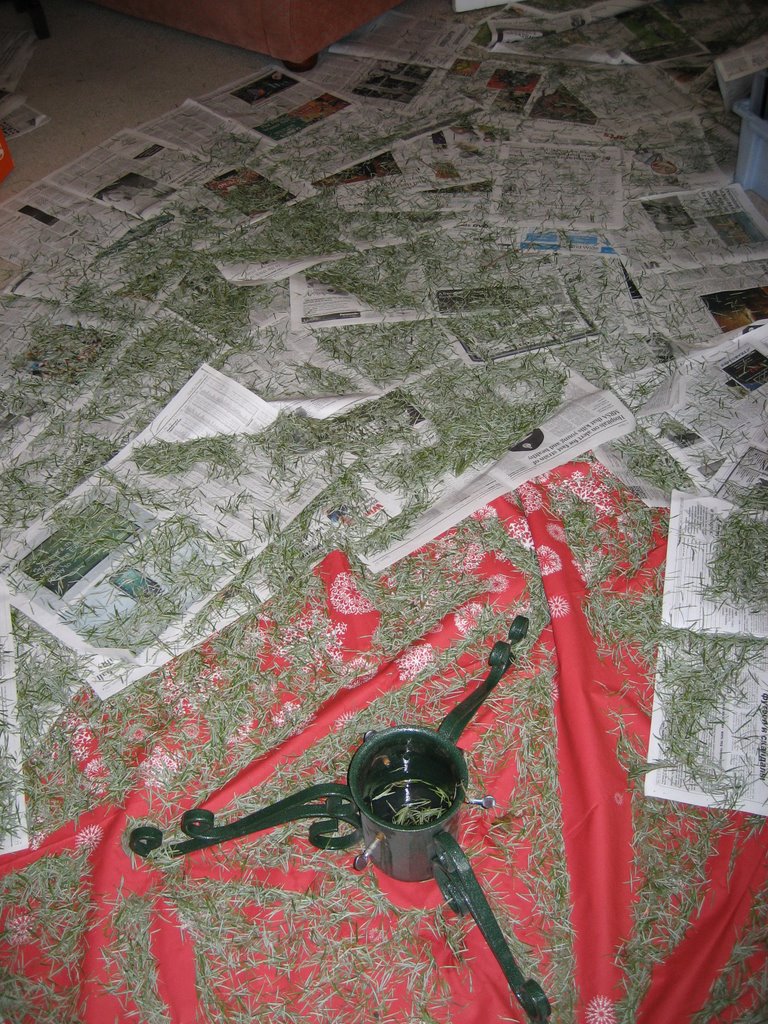
Again, view from the high point, this time towards my house across the old quarry that's been made into a sort of park. Finally, something completely different, taken at home on Twelfth Night 2007:

Next year we'll be getting a non-drop one.

Sunday, December 17, 2006

End of Act 1

Yep, my stay in Aachen is coming to an end. For now, at least. I've spent the best part of four months here now, and will return in January for the best part of five after a (hopefully) choclate-and-turkey-filled interval. I'm trying not to think about how fast my year abroad is evaporating, nor about how much my German is improving. It'll be worth it just for the Dutch I've learned, though, because although I say it myself my Dutch is now actually pretty good. A small group and an excellent teacher who conducts the whole lesson in the target language have been contributing factors in this, and of course the fact that the rest of the group (with one exception) are native speakers of German. This technically puts me at a disadvantage, because the languages are so similar - a very large proportion of words in the two languages are fundamentally the same word, spoken and written slightly differently. In actual fact, however, it spurs me on. I've never really tried to learn a language in a group in the UK outside of school, so I can't really judge, but I have a feeling that the pace would be far too slow for me to really sink my teeth into it. Here the pace is fast, as much of the language's grammar needs little or no explanation where in English it would need to be explained in detail. This is challenging, but ultimately more rewarding and enjoyable. My last lesson of the third course is tomorrow (Monday), and it may well prove to be my last ever formal Dutch lesson, as the fourth course won't go ahead unless eight people sign up. But I now have the tools to just go out there and immerse myself without drowning in unfamiliarity. Yay!

Another two Christmas markets have been visited, one in the town of Jülich and one in my local village/suburb of Brand. Jülich disappointed, but that was probably only because of the continuous drizzling rain. Besides, I had a wonderful Dampfnudel with hot vanilla sauce and cherries, so it wasn't all doom and gloom. Brand was the smallest affair so far, but picturesque. Three girls were standing on a little stage playing carols on flutes, which was cute. Plus it wasn't raining.

On Tuesday I'm off to see ETG's performance of Macbeth in Liège, and I'm really looking forward to it. ETG was AWESOME last year, and if the show's even two fifths as good as Taming of the Shrew it'll be worth the trip. Then on Wednesday I fly back to the UK. I don't know if I'll be blogging over Christmas; probably not, as there are so many more fun things to do. So I guess this is a temporary goodbye from me to all my loyal readers. That is, after I've finished with the...

Ritter Sport Ratings

Yep. They're back. Because there's a new flavour in town.

Whole Peanut: 6/10
I get the feeling that this is just the Golden Peanut from earlier in new packaging. And WHAT new packaging. OK, Ritter, you may have already used all the colours of the rainbow, but that doesn't mean that you have to use luminous orange! Ick. It made me want to vomit just looking at it. Eating it, on the other hand, was far more of a pleasure than I remember. I think I said it was an incongruous combination, but it didn't feel like it this time. Maybe they've tweaked it, or maybe I was in a better mood to receive it. Either way, this one now places at 6/10, between Amaretto Truffle and Hazelnut (white chocolate).

Bye for now, and I wish you all a merry Christmas and a happy New Year!

- G.

Sunday, December 10, 2006

Escape from the Christmas Market of Doom

Christmas markets.

It's what you do when you're in Germany and it's, like, December, innit? I certainly did. Last weekend I headed into town and visited Aachen's bloated sprawl of a Christmas market, and I've just got back from visiting one in the much-cited picturesque town of Monschau. They're certainly popular. In both markets I found it difficult to move around in the crowd, and in both markets I ended up standing in a queue for an excessive amount of time when I decided that what I really wanted was something sweet and filling (Nutella crepe in the first case, waffle with cherries and cream in the second). Both markets also FUBARed the area's transport network. Take my advice if you're ever in Germany at this time of year: don't use the roads. If you can't get somewhere by walking/taking the train, don't go there at all. It is inordinately difficult.

Take today as an example. I got there just fine; it was getting back that was the problem. Conscious that there would be a lot of people trying to get out of the town when the market closed, I a) set off a little earlier and b) waited for nearly half an hour at the bus stop before the bus was due to come, so that if a queue formed it would form behind me. (This was a tactical error. I should really have remembered that Germans can't queue to save their lives. Instead they just mill around aimlessly and shove each other out of the way. Strange behaviour for a nation that's otherwise generally much more civilised than ours.)

Neither measure availed me. The problem was the park and ride service. Monschau, being a small town with very, very limited road access, decided this year to cut the town off entirely to normal traffic. This ban extended to all the tour buses that visit the town (and there were about 30 of them in the nearest car park up the hill). A park and ride service was being offered from several very large car parks just outside the town - and boy, was it necessary. During the time I was waiting there, despite a bendy bus coming about every five minutes, the number of people waiting for a park and ride bus back to the car park was never less than about 200. All well and good, I thought. They're waiting at a different bus stop. But when my bus finally came, about ten minutes late, it stopped at the park and ride bus stop - and people started getting on. About half of the people waiting for my bus ran across the road and piled on, while the rest, including me, kept standing there, thinking: It has to come to this stop. The stop it's supposed to come to. Right? Wrong... the bus drove off without me. Crap, I thought. There's only one bus left that goes back to Aachen, and it's in two hours' time, and it's bitterly cold. Plus, if this bus was bad, when the market hadn't even closed yet, what would the next one be like? The German word "sauer" is one that I'd never really understood before today, but standing there in the cold it was a shockingly accurate description of how I was feeling.

To cut a long story short, after briefly considering staying the night in Monschau and going back the next morning, I got a taxi home. It was the only other way. So I sat there, chatting to the taxi driver, watching a tour coach in front of me belonging to the unfortunately titled company "Bustouristik Fucker", and intermittently glancing at the ever-increasing kilometre count on the display. An expensive day out, all told. A large number of euros out of pocket, and entirely because of bad organisation. Gaaaah.

So, anyway. Christmas markets. The taxi driver couldn't really see the attraction, having lived in Germany all his life - and I could actually see his point. In fact, it's one I'd been considering since the previous weekend, in Aachen. Because what is a Christmas market, in essence?

There are little wooden booths. Some of them are fast food stalls. Big deal - we get those in the UK as well, and although the good quality stuff's probably better in Germany, the principle's still the same as at the dodgy fairground trailers in the UK. Not all of it's brilliantly original, although some is pretty special. In Aachen there was a lovely stall selling portions of fried mushrooms with a vast array of sauces. Admittedly I didn't feel like fried mushrooms at the time, and I can't really think of a situation where I would ever choose a portion of fried mushrooms on their own over just about any other type of food. But that's beside the point. It was an original and fun idea and put a smile on my face.

Some of the booths sell Glühwein. A lot of them, in fact. But what's Glühwein? And why do we persist in calling it Glühwein? It exists in the UK too, and is relatively common, and there it is called mulled wine. So I don't really understand why British people always call the German version Glühwein and get so obsessed with it. On the other hand, it is pretty nice, whether mulled or Glüh.

The vast majority of the booths, probably 60%, sell... trinkets. Made of glass, or wood, or plastic, or bone, or anything really, and ranging widely in quality. In the UK it's not so easy to get your hands on hand-crafted Christmas decorations, but they can be found, and in the same sort of qualities as in Germany. The German varieties seem to be bound by two main guidelines:

1. Items must be substantially overpriced for what they are.
2. Items must serve no useful function whatsoever.
(A less significant guideline is 3: Where possible, items should be of a consistency such that it is impossible to remove them to a distance of more than about 100 metres from the stall where you bought them without them breaking in your pocket/bag/hand/car).

The items are also very pretty, a lot of the time, too - and sometimes very kitsch. All in all, not a good enough reason to get a coach over to another country, in my view.

Finally, the remaining 10% of stalls tend to sell local produce. These are the ones that float my boat. I love seeing locally made wines, and honey, and mustard, and sausage, and lebkuchen, and all that... and if anything makes it worthwhile visiting a Christmas market, that's it. Because that's the sort of stuff that you can't find anywhere else, and is often really good to boot.

I'm probably being a little too nuts-and-bolts in my analysis of German christmas markets, here; but the fact is that I'm baffled as to why people come from abroad on coaches. Christmas markets are very nice, yes, but are they really THAT special? Judging by the fact that people keep on visiting them, I guess they are. Then again, I reckon at least two thirds of the voices I heard at the Christmas markets were speaking English, French, Dutch or some other language rather than German. Being so completely Europolitan, the Aachen area isn't a great example for this purpose - but it still shows that the vast majority of people visiting Christmas markets are foreigners. Maybe it's something you learn to take for granted. Maybe I'm in the process of learning to take it for granted - I have visited markets in Strasbourg, Freiburg and Munich as well as the two that I visited this year, after all. I don't doubt that I very much enjoyed my two afternoons out this weekend and last. But I enjoyed them in the same way as I enjoy a play or a film - and would the average person travel 1000 miles on a coach to see one of those? Perhaps so. The simple pleasures can't be underestimated, and the German Christmas markets certainly are a celebration of the fact that Life Is Good.

Sunday, November 26, 2006

Casino Royale

I went to see the latest Bond film yesterday evening.

It was certainly a step up from Die Another Day. No more hilarious technologies and ridiculous characters. This is a pared-down Bond film, and is much darker and more realistic than some of its predecessors as a result. Whether this made it a good film, though... the jury's still out.

The poker scenes tested my patience. As well as being clumsily cut, such that I didn't really know if the action had moved forward or not, it had Bond's associate "narrating" the game in a most tedious manner. Fair enough, for a general audience it couldn't really have been done any differently, or it would have been too opaque; but it's a good reason not to have a card game at the centre of a major film. At least it wasn't Shithead. I was looking forward to some double, triple and even quadruple bluffing, too, but in the end I was treated only to one fairly half-hearted and predictable double bluff from Le Chiffre. Which brings me on to another thing...

The characters were not only believable in this film, they were more than a little bland. Le Chiffre made a poor villain, in my opinion. He was uninteresting, even with the "special quirk" ubiquitous to Bond villains, in this case the crying of blood. I read White Teeth by Zadie Smith only a couple of weeks ago, where this trait is also used for shock value, so it did nothing for me. Nor did his predilection for "interesting" torture, in the form of some excessive testicle-bashing, "do it" for me. OK, he's a bit of a sadist weirdo... just like all the other Bond villains. Le Chiffre compounds his uninterestingness by inconsiderately getting himself shot in the head about three-fifths of the way through the film, and after that the entire film seems completely aimless.

On the plus side, Daniel Craig makes an interesting Bond. I don't think he'll outshine the others (except Lazenby), but it really depends on what you're looking for in a Bond. He reminds me a bit of Timothy Dalton, but less gentlemanly and more physically believable... but that could just be because Bond shows emotions again in this film, something that Pierce Brosnan never really got the chance to do, with the exception of a bit of righteous anger here and there. Whether this is a good thing or not... I'm undecided.

There were also two wonderful action scenes at the start of the film, which managed to impress even me, jaded big-screen adrenaline junkie that I am. So not a loss of an evening, all told.

Sunday, November 19, 2006

More chocolate, more trains

Hello everyone! I'm not going to apologise for not posting for three weeks. Well, I'll apologise for not posting for two weeks, but really, if I'd posted on the 4th-5th weekend I would have been incredibly boring, because nothing happened the weekend before and nothing much happened that weekend either. So I actually did you a favour by not posting. At best you would have got a rant, but it wouldn't have been a particularly impassioned one, as I didn't have anything much to rant about.

Last weekend was a different kettle of fish, though - and in fact the last two weeks in general. I've been so busy that in that time I haven't really had the energy to post until now. On top of my Dutch classes on Monday and Wednesday evenings, I've been going to a theatre group on Tuesdays, and I've met my Konversationsparterin twice, so a lot of long days. In the meantime, I've been accepted as a full moderator on Tazlure, and posting there has been taking up a lot of my time.

Last Saturday I hopped on the train to visit Lynsey in Giessen. I'd been warned by multiple people that it wasn't the prettiest place in the world, having been largely flattened in the war, and those people proved to be more or less right. It was however made a million times prettier by the fact Lynsey was there, and seeing a familiar face for the first time in two and a half months made me very happy. But I get ahead of myself.

Due to my long and exhausting week, I was hoping that the three-and-a-half hour train journey would allow me some time to rest and recuperate. It was, however, not to be. To my horror, the train was packed to bursting with people in silly costumes, drinking beer (yes, on the train, in large quantities, at 9am - many seemed to already be drunk) and singing loudly. A few seats behind me, some shameless bastard had brought a ghetto blaster onto the train, which was pumping out crappy German folk-pop anthems, and periodically a group or other would start to "sing" along and clap their hands. I later learned that that day, 11/11, is traditionally the start of Cologne's Karneval season, which culminates in February. Germans being (largely) the sober, rational lot they are, they don't stay pissed throughout the whole three-month period but mark the start and end with bouts of temporary and excessive bladderedness. Luckily they got off at Cologne, and I was left to find a comfy place for myself amid a garden of discarded beer bottles.

Exactly the same happened on the return journey, except that people were more drunk and more subdued. The German inability to queue was made even worse, as I found to my cost when trying to buy a sandwich at a bakery in the station (I had to change trains on the return leg). After three groups of people pushed past me in the queue and ordered by dint of shouting loudly and repeatedly at the guy serving, I finally lost it, and, I'm sorry to say, did the same myself. I wasn't going to get anywhere by doing anything else, and I had a train to catch. If you can't beat 'em, join 'em... or just beat 'em by joining them. :)

The whole experience made me realise how much I hated "festivals", "carnivals" and any of these events where people feel that it is their God-given right to stagger around being loud and drunk and disregarding the norms of basic courtesy in the name of "having fun". Even more sadly, I feel like I'm in the minority here. I just can't possibly have fun when there are people around me like that, and I can't do it myself. Singing loudly and tunelessly, being pointlessly aggressive in minor ways and drinking too much just isn't my idea of a good time. Maybe I'm simply betraying my weirdness here, but frankly it saddens me that people feel the need to act so brainlessly. Every now and then something will happen that makes me feel joyful about being a human being - usually it's seeing some great work of construction, like a magnificent railway viaduct or a great church or cathedral. But then I'll bump into a crowd of people like those I've mentioned, and it's instantly counteracted. It's a terrible thing to say, I know, but it makes me realise that I only really give a shit about - at a guess - 10% of the world's population. The active, intelligent 10%, the ones who try, and think, and move things forward. It says a lot for their efforts that in my mind they succeed in counterbalancing the ignorant, turgid uselessness of the other 90%.

It's an extreme view, I know, and not one that I hold the whole time - the exact ratio varies from day to day. ;) And what do I advocate doing about it? Well, on a general scale, nothing. We can't just kill them, or send them to Australia, or something. So my personal take on it is to avoid them as much as possible. Does that make me a bad person? I'm not sure. All I know is that I've grown up surrounded by "normal" people, and have ALWAYS wanted to get away from them as far as possible. That's why I've never been happier, on the whole, than when I'm in Cambridge. O' course, not everyone there's the kind of person I want to associate with... but there's certainly more chance of meeting such people there. At the end of the day, though, I'm satisfied with my choice. It's nothing more than a preference for friendship, and I don't and won't go out of my way to rubbish, ridicule and be rude to the others... even if they do it to me on a monotonously regular basis.

Aaaaaaanyway, me and Lynsey had a nice chat and a meal, wandered around Giessen for a while, and visited the Mathematikum - an interactive museum with lots of neat geometrical puzzles and stuff. A place for kiddies, really, but still awesome fun. :D On the way back I bought the book Memoirs of a Geisha, by Arthur Golden, because I'd been foolish and left my own books at home. During the long, dark train journey I burned through more than half of it. I'm still reading it, and enjoying it greatly. It's a wonderful book.

This weekend, yesterday, I took a trip to Cologne. Another bombed city, other than the cathedral there's not much exciting visually there either. The cathedral itself, although beautiful externally, was a disappointment from the inside. It was badly lit, and there was a service going on, and the entrance foyer for viewing was packed, so I didn't stay long. I headed on down the Rhine to a chocolate museum, a mighty institution with its own little chocolate factory where you could walk around and follow the whole process from crushed cocoa bean to packaged product. Lovely.

Gah. Without the Ritter ratings, I really don't know how to end a post. Maybe I'll just do it like this.

Saturday, October 28, 2006

River valleys, bright lights, stupidification and the end of an era

Last Sunday I set out on my most ambitious walk yet. My starting point was Monschau, the picturesque little town I mentioned earlier - which, on second viewing, gets an upgrade from "picturesque" to simply "beautiful". Stopping briefly to grab a few Brötchen for the day's lunch, I set off down the Rur valley.

The river Rur was to be my companion for the next 20 miles as I followed its development from streamlike status into a vast reservoir providing much of the water and power for the Rheinland. The first few hours were some of the most lovely of all. Dew still sat on the fallen leaves on the path underfoot, and the air still held that refreshingly sharp, prickly quality peculiar to rural mornings. Most importantly, for about 8km downriver from Monschau there is no road in the deep valley. Having grown up in the UK, where almost every valley of any size has its own metalled road and the accompanying insectlike buzz of traffic, I immediately fell in love with the place. Another Vorteil for Germany.

After meeting a road, the path crosed the river at a bridge and then rose up onto the wooded hillside on the other side, hugging the contour. At a particularly spectacular viewpoint I stopped for a Streuselbrötchen (German speciality: a shortbread-encrusted bread roll. Sounds weird but is delicious). From this point onwards villages started to emerge in the valley. A good while later, about lunchtime, I arrived above Einruhr, where the reservoir proper begins. Here, again, I got to follow a path along the edge of the lake, watching cyclists zip past me and the occasional boat chugging through the water. 5km later I was in Rurberg, where a dam separates the upper from the lower reservoir. I grabbed an ice cream and pondered my next move.

The problem was that the path along the lakeside was awfully long: 13km, to be specific. The map clearly showed a more direct route over the hills, so this was the one I took. Mistake? I suppose I'll never know. In any case, the ascent, about 500m of height in 1.5 km up the hillside, was ache-makingly persistent, and combined with the bright sunshine nearly did for me. Still, the views from the top were amazing. The Rurtalsperre reservoir is incredibly wide at its end point, and in its centre is a wooded, uninhabited island, of the sort you just want to grab a boat and row out to. I descended the hillside by way of a bendy mountain road, and after being passed by at least 50 motorcyclists I reached the Rurtalsperre dam, an incredible edifice. On one side is a beautiful view of the lake; on the other, the valley floor, a dizzying distance below, makes it clear just how deep the reservoir really is. From this point it was only a few more k to a little railway station at the end of a branch line to the middle of nowhere (Heimbach).

In other news, I'm writing this from an Internet cafe again, as my home connection is broken, a mere few weeks after being set up in the first place. The man at tech support seemed to think it was to do with the modem being switched off at the mains every night. I personally think that it's fair enough to do so, as the modem doesn't have its own on/off switch and bright lights in a room where I'm trying to sleep really annoy me. Leaving it on while not in use (as seemingly advocated by Alice tech support) is a waste of energy as well as an annoyance. This particular bugbear is one I've been fighting against for years. In my room at home I have a stereo, and an expensive one, too, with a little light that stays on even if you press its off switch. The only way to kill it entirely is to switch the thing off at the mains - which has as its side-effect the loss of all radio station settings. I had to live with it, in the end. In my opinion, though, it's just bad design to create appliances which aren't allowed to lose power. It is irritating to the consumer and a waste of energy, as I mentioned, but it also displays an incredible lack of foresight on the part of the manufacturer. In Derbyshire, at least, power cuts are far from uncommon, and nowhere is entirely safe from them. (For example, when I was in London the Haagen-Dasz cafe I visited was pretty much taken out of action by an outage in Leicester Square). Surely it can't be that hard to make appliances which need to store information actually store it, as in computers?

One rant is over; another begins. This one's about literature, or, more specifically, a tendency in literature: the tendency to present people as "simple".

I first came across this when I was working on a production of Shakers, by John Godber. I loved the play, the director, the cast, the adaptation - but there was something about the characters that bugged me. It was this: they weren't very clever. Now, don't get me wrong, I have absolutely no objection to lack of intelligence. What I objected to in this case was that entire scenes of the play seemed to be predicated on a certain "simplicity" on the part of its protagonists. Laughs were being drawn from it. Not hearty guffaws, but polite, elegant chuckles at the basic nature of these cocktail waitresses and their "amusingly" blunt or insightless statements.

This came up again when I was in Paris at the Sorbonne. We were reading a text by Maupassant about the commoners of his (rural) region going to market. The course teacher asked us if Maupassant was laughing at these "simple", "basic" people. NO! was of course the answer that was required. Maupassant has, of course, much affection for them, and is simply reporting things the way they are. But I wanted to stick my hand up and say YES! You can't write about how simple and basic these simple, basic (hereinafter referred to as SB) people are without a certain imagined superiority creeping in. Even the implication that these SB people's minds were somehow closed to "higher" things reveals this. I was only prevented from saying this by the fact that my French really wasn't good enough to discuss that kind of thing back then.

I put it out of my mind for a few years - until I read Captain Corelli's Mandolin.

Now I could devote several blog posts to a full explanation of why I hated this book, but the linchpin of my many diagreements with it is the characterisation. Not a single character in the book was believable to me. The village in the book was clearly the sort of "pastoral idyll" inhabited by SB people that I can't stand reading about. You've got the SB communist, the SB royalist, the big strong SB man, the young, carefree SB man... a full cast of them. There are, of course, exceptions. The young, zealous Nazi who comes to realise that what he's doing is wrong. The bold, cheerful, dashing, stiff-upper-lip British officer whose honour proves to be the end of him. These are just clichés. Then we have the central characters, Corelli and Pelagia, each of whom would in roleplaying terms be described as a "Mary-Sue" (or, in Corelli's case, perhaps a "Gary-Stu"). They can do no wrong and are devoid of any particular failings whatsoever, save those which are excusable as fundamentally human. As protagonists they simply managed to infuriate me through their constant, tedious perfection. The nail in the coffin is Pelagia's father Iannis, a man who has travelled the world and holds a doctor's qualification yet shows no signs of any kind of irony when he advises his daughter Pelagia against moving to Italy on the basis that they can't make good meat pies like the Greek can. Hm. Seems that once SB, always SB, no matter where you go or what you learn. He was the hardest to swallow of the whole two-dimensional lot of them.

At the moment, I'm reading "White Teeth" by Zadie Smith. An enjoyable, insightful book in many respects, but even here a bit of SBness creeps in, such as when Joyce Chalfen, an Oxbridge-educated middle class woman, asks a pair of lesbians who've been brought round to visit by a friend whether they use each other's breasts as pillows.

I'd love to say that I have absolutely no idea why writers do this, but the truth of the matter is that it's all too clear. This "affectionate" presentation of SB people is there for cheap laughs. So that the university-educated reader can sit back in his armchair and internally go "Ho, ho, ho. These SB people and the things they say. I'm so glad that I am middle-class, educated, tactful and well-rounded, and all in all a level above these SBs. But I do love to read about their delightful little antics."

Rural people suffer the worst from this (which I, as someone brought up in a small village, strongly resent), but the last example shows that urban dwellers are not immune to it either. However, my experience shows there are very few communities of SB people. In fact, there are very few SB people, period. People have different priorities, different motives, of course! But the sort of shit-headed SB oblivion that "good-hearted, affectionate" literary fiction portrays is virtually non-existent. Writers: pack it in. These people are not a fair target, whether existent or not. The truth is far more complicated. People are far more complicated. And I for one would like to read about real, perceptive people, rather than being assailed with stupidification intended to elicit a few cheap laughs and a fleeting feeling of superiority.

Ritter Sport Ratings

Rum, Raisin & Nut: 8/10
I was surprised to find that I preferred this one to its non-alcoholic counterpart. The rum hits a taste register that otherwise remains unused, in effect adding another dimension to its taste. Not just crunch and squish, but crunch, squish and oooooh.

Whole Almond: 4/10
Nah. Having tried the Hazelnut varieties so recently, I found that almond is a poor substitute. It's that bit squeakier between the teeth, and its crunch is feeble compared to that of the mighty hazelnut. Not a winner.

Diet Half Dark Chocolate: 1/10
Eeeeew. Ritter, WHAT WERE YOU THINKING? This is just as dry as the non-diet variant. In addition, it tastes of nothing very much, except possibly bicarbonate of soda. Ick ick ick. What a terrible way to end a great series.

End, yes. This is the end. For, ladies and gentlemen, in my two months in Germany so far I have now tried out every brand of Ritter Sport available in German supermarkets. The league table is presented below. Fear not, for I will try my damnedest to get my hands on others, because I know others exist. In Munich, for example, I remember sampling a Cognac flavour Ritter Sport, and of course the legendary Baileys flavour. Sadly my memory is not good enough to compare one I ate three years ago to one I ate today. But I will hunt them down and bring them to you, my dear adoring public!

League Table
1. Rhubarb, strawberry and yoghurt: 9/10
2. Milk Chocolate: 9/10
3. Alpine Milk Chocolate: 9/10
4. Crunchy Biscuit (Knusperkeks): 9/10
5. Nougat: 8/10
6. Cappucino: 8/10
7= Hazelnut (milk chocolate): 8/10
7= Hazelnut (dark chocolate): 8/10
9. Fine Dark Chocolate (Edel-Bitter): 8/10
10. Rum, Raisin & Nut: 8/10
11. Marzipan: 7/10
12. Blood Orange: 7/10
13. Raisin & Nut: 7/10
14. Vanilla Liqueur Truffle: 7/10
15. Knusperflakes (Crunchy Flakes): 7/10
16. Sunny Crisp (sunflower seeds): 6/10
17. Espresso Crunch: 6/10
18. Half Dark Chocolate: 6/10
19. Amaretto Truffle: 6/10
20. Hazelnut (white chocolate): 6/10
21. Dark chocolate with Creme a la chocolate mousse: 5/10
22. Jamaica Rum: 5/10
23. Kakaocreme (Cocoa cream?): 5/10
24. Peppermint: 5/10
25. Whole Almond: 4/10
26. Golden Peanut: 4/10
27. Yoghurt: 4/10
28. Lemon: 3/10
29. Coconut: 2/10
30. Diet Half Dark Chocolate: 1/10