Monday, May 08, 2023

Max Müller, Chomsky, and linguistics as science

A while ago I posted the following brainteaser on Facebook:
“We do not want to know languages, we want to know language; what language is, how it can form a vehicle or an organ of thought; we want to know its origin, its nature, its laws”. Who wrote this, and when? (No Googling!)
The question elicited a lot of educated guesses. Some associated it with current thinkers in the Chomskyan mould: see for instance Norbert Hornstein's discussion of linguists vs. languists. The word "organ", meanwhile, is reminiscent of Anderson & Lightfoot's 2002 book The Language Organ. Flagging up these similarities was precisely what I was aiming at in asking the question! The actual author of the quotation was Friedrich Max Müller (1823–1900), in his 1861 lectures.

Engraving of Müller by George Perine, pre-1885

Müller, a German-born academic who spent his career in England, is a fascinating figure. He absolutely dominated the linguistics scene in his time, especially in Britain, yet history has not been kind to him. Hornstein, for instance, was candid about the fact that he didn't know who he was. Cartesian Linguistics, where Chomsky most famously situates his thought in relation to its predecessors, has no mention of Müller, and Chomsky (p.c.) states that Müller's ideas did not influence him. Historically this is perhaps unsurprising: Müller’s ideas mostly died with him. (Exactly why this happened is an interesting question in its own right, and I may return to it in another post some time.)

Müller died in 1900, and for the most part only historians of ideas have paid attention to his oeuvre since. Lourens van den Bosch's 2002 biography and survey, Friedrich Max Müller: a life devoted to the humanities - henceforth vdB - gives a thorough overview of his life and work. More recently the Publications of the English Goethe Society devoted an issue to Friedrich Max Müller and the Role of Philology in Victorian Thought. Neither of these sources particularly focuses on the parallels between Müller's ideas and today's linguistic thought, however (vdB has a few comments on this, but he is writing from the perspective of a historian of religion). This blog post is intended to draw some of these parallels to the attention of today's reader. In particular, I think there are at least four points where Müller's thought shows a striking similarity to ideas expressed by Noam Chomsky more recently:
  1. Linguistics as science;
  2. The relation between language and thought;
  3. The evolution of language;
  4. (more speculatively on my part) The role of infinity in human exceptionality.
This blog post focuses only on the first point; I'll try to return to the other three points in future posts. 

A note on sources: SL stands for Lectures on the Science of Language, published in two volumes between 1861 and 1864, and is the clearest statement of Müller’s linguistic thought.

Linguistics and natural science

Müller took a position opposed to the Scottish school of thought that held that language was a work of human art (vdB p214 mentions Locke, Adam Smith and Dugald Stewart). Müller’s argument against this was the largely unconscious nature of language change: “it is not in the power of men either to produce or prevent it. We might think as well of changing the laws which control the circulation of our blood, or of adding an inch to our height, as of altering the laws of speech” (SL). Darwin, who read Müller and corresponded with him, took a compromise position in Descent of Man (1871), describing language as “an instinct to acquire an art”.

Although Müller acknowledged the historical approach to language – and in fact spent most of his career focusing on this approach himself – he was also convinced that language could be approached as a physical science, or natural science: “with one foot language stands, no doubt, in the realm of nature, but with the other one in the realm of spirit” (SL). He distinguished philology, the study of languages for the purpose of understanding historical documents, from the science of language (see the brainteaser quote at the start of this post), whose main practical tool was comparative philology.

In labelling the study of language as a physical science, Müller was reacting against the famous 19th-century geologist Whewell’s distinction between Natural History (the physical sciences) and Human History (historical or moral sciences, the study of the contingent), and in turn, according to vdB, this probably derived from Alexander von Humboldt’s division between Naturwissenschaften and Geisteswissenschaften, a toxic dichotomy that continues to shape German and worldwide academia. It’s anachronistic to think that Müller was arguing that language belonged to the study of physics specifically.

The idea of linguistics as a physical science was anathema to the Yale linguist William Dwight Whitney, whose posthumous reputation can only be contrasted with Müller’s: while Müller is largely forgotten, Whitney is lionized, despite Whitney’s scholarly oeuvre being (as far as I can make out) substantially less original and more reactionary, and despite the fact that one of the ideas he is commonly credited with popularizing – uniformitarianism – was actually brought into linguistics by Müller and taken over only later by Whitney. The two were enemies for much of their lives, and Whitney devoted substantial energy to throwing shade at Müller, even suggesting that one of his major scholarly achievements, his edition of the Rigveda, was not by him at all, and getting his students to propagate this view (see vdB p486). Whitney even wrote a whole book, called Max Müller and the Science of Language, with no purpose other than muckraking at Müller’s expense. In his overview of the history of the field, Bloomfield’s Introduction to the Study of Language (1914) praises Whitney to the heavens, but makes no mention of Müller, even while arguing strongly that language can be treated scientifically (calling it a “mental science”) – exactly the opposite of Whitney’s view on the issue: Whitney describes the study of language as a “historical or moral science”, precisely on the other side of Whewell's dichotomy (Morpurgo Davies 1999: 208). Alter's (2005) ironically-named book “William Dwight Whitney and the science of language” has a good chapter on the Whitney-Müller clash, if one that also comes down rather heavily in favour of Whitney.

The Müller-Whitney “debate” is reminiscent of the rationalist-empiricist clashes of today, and it hardly needs to be said that Müller’s stance on linguistics as a science is also Chomsky’s (see Aspects chapter 1, Cartesian Linguistics, and Joseph 2002: ch. 2), though the issue is hardly particularly controversial nowadays. Chomsky’s own writings don’t suggest that this was a recognition he had to fight hard for: we’ve seen that Bloomfield treats language scientifically, Saussure was more psychologistic than he is usually credited with being (see Joseph’s biography), and even behaviourist approaches also viewed language (qua behaviour) as a valid subject of scientific enquiry (contra Whitney). Where Müller and Chomsky differed from these linguists was in the nature of the science. That said, one major distinction between Müller and Chomsky is the role of religion in the distinction: “Physical science deals with the works of God, historical science with the works of man” (SL). But thinking of Müller’s God in a fully present-day Christian way is also a mistake – I’ll hopefully come back to this in a later post.

Conclusion

Why are these similarities found? I'm not really a historian of linguistic ideas, so I can only point to a couple of possibilities. The obvious one is shared influences, of which Wilhelm von Humboldt (one of the heroes of Cartesian Linguistics) is probably crucial, and through him also Herder. There's also the possibility that Müller and Chomsky came across the same ideas independently because they made sense and were a good fit for the evidence; i.e. the ideas are right. (Hey, you can't rule it out!)

But there are also lots of areas in which Müller's and Chomsky's ideas diverge wildly, of course. Müller never paid much attention to syntax at all, and Chomsky has never paid much attention to diachronic linguistics. For Müller, individual lexical items and their historical development (“roots”) were crucial, while for Chomsky the combinatorial mechanism is. And it's a stretch to call Müller's approach psychologistic in any sense; moreover, other things that Müller proposed, like the Turanian macrofamily, turned out to be bunkum. But in any case, it'd be nice to see these similarities (as well as these differences) getting more attention in future, and hopefully this blog post might provoke thoughts along these lines.

Thursday, April 06, 2023

Evidence for a Germanic Easter goddess?

A claim you often see round about this time of year is that the word Easter comes from the name for a pre-Christian goddess. The aim of this blog post is to weigh up the evidence for this claim.

Depiction of “Eastre”, by Jacques Reich (1909)


The oft-repeated story goes something like this:

“The English word Easter corresponds to German Ostern. Both forms derive from the name of the pagan Germanic goddess of spring, Eastre. Her name is probably related to the English word east (German Ost), which connects her to dawn and to the rising of the sun.”

This version’s taken from a recent column by Peter Trudgill, “How the pagans gave us Easter”. And it’s dotted about here and there in popular culture. The video game Assassin’s Creed: Valhalla, for instance, has a quest relating to Ostara, a goddess of fertility; this is another version of the same name (more on this later). She also shows up in the American Gods TV series. But how do we know about this purported “pagan Germanic goddess”?


Bede’s story


It comes down to a single source: Bede’s Reckoning of Time (De Temporum Ratione), written in 725. Here’s what he says:

“Eosturmonath [April—GW] has a name which is now translated as “Paschal month”, and which was once called after a goddess of theirs named Eostre, in whose honour feasts were celebrated in that month.” (trans. Wallis 2004: 54) 

“They” here refers to “the English people”.


Bede, once thought of as a paragon of respectability and objectivity, is now viewed more sceptically by historians: whatever his merits as a scholar, he was not above twisting the facts of the matter in ways that suited him (see e.g. Goffart, Narrators of Barbarian History). Would he invent a goddess? Or perhaps two? Another goddess, Hretha, is also mentioned in this passage just beforehand, in the context of the name of Hrethmonath (March). Like Eostre, she’s only mentioned here, by Bede. 


The Oxford English Dictionary (s.v. Easter) makes reference in its etymology to the goddess, and to scholars who suppose that Bede invented her. They respond that it “seems unlikely that Bede would have invented a fictitious pagan festival in order to account for a Christian one”. Perhaps; perhaps not. Careful readings of Bede can reveal many motivations that might not have been obvious on the surface, as Goffart has shown. One such might be simple parallelism: if March is named after a goddess, why shouldn’t April be, too? But there’s also a non sequitur in the OED’s reasoning: it’s the goddess that’s in question, not the festival, and we could in principle perfectly well have the latter without the former. In any case, Bede’s story receives no corroboration of any kind from any other sources, so we can either choose to take him at his word, or not.


Jacob Grimm certainly chose to, and more. In his Deutsche Mythologie – first published 1835 – he takes Bede’s story and runs with it, speculating wildly.


An Old High German lullaby?


Another purported source for this goddess is an Old High German lullaby. This was discovered in 1852 by Georg Zappert, and includes the line Ostârâ stellit chinde / honak egir suozziu “Ostara provides the children with honey and sweet eggs”. It doesn’t explicitly say she’s a goddess, but we’re clearly dealing with an agentive subject of some kind here.


Unfortunately, the text is almost certainly a forgery; see the German Wikipedia entry for discussion and references. One argument for this is the sheer convenience of it: after Grimm in his Deutsche Mythologie in 1835 speculates about the existence of an Easter goddess and bemoans the lack of evidence from beyond Old English, boom! Along comes a text that provides supporting evidence, within twenty years. So we’re back to square one.


An Old Saxon hymn?


Another source, almost as dodgy, is a supposed Old Saxon hymn. Hocker (1853: 224) mentions a hymn preserved in the monastery library at Corvey that starts Eostar Eostar, eordhan modor “Eostar, Eostar, mother of earth”. Montanus (1854: 28) has a fuller version.


The text is very close to an extract from an Old English text, the Æcerbot (“field remedy”) . In the better-known Old English version, the name Erce is found, not Eostar. Montanus describes the Eostar text as Old Saxon, but the very name Eostar makes this dubious: the digraph, presumably representing a diphthong, is not something we’d expect to see in Old Saxon, since the expected outcome of Proto-Germanic *au is a monophthongal long /o/ in this variety.


More problematically, it’s not clear that the Eostar text referenced by Hocker and Montanus was real. More recent compendia of early German texts don’t contain this one, and I’ve been unable to find any source from the twentieth century that doesn’t refer exclusively to Montanus or Hocker. This raises two possibilities. First, like Zappert’s lullaby, the manuscript could have been a contemporary forgery (and for potentially for the same reason: it very conveniently fits Grimm’s narrative). Secondly, the supposed manuscript may never have existed at all: Hocker or Montanus might have simply invented it. It’s not at all easy to trace what happened to manuscripts from Corvey, but until this one physically shows up somewhere, the corroborating value of this particular source is virtually nil.


Votive inscriptions?


A final potential source is a set of votive inscriptions to the matronae Austriahenae, discovered in 1958. Philip Shaw’s 2011 book Pagan Goddesses in the Early Germanic World considers these to be fairly conclusive evidence in favour of a goddess, but I’m not convinced. First, the matronae are plural, not singular. Secondly, while Shaw goes to some length to argue that Eostr- and Austr- could be cognate – and I agree – what’s the -iahenae doing there?


Interim summary


I’ve discussed four sources: Bede’s Reckoning of Time, an Old High German lullaby, an Old Saxon charm/hymn, and some votive inscriptions. Of these, the second probably isn’t real, the third may well also not be, and the fourth doesn’t tell us anything useful. So we’re left with Bede, realistically.


But let’s consider what conclusions we can draw.


A Germanic goddess?


The cross-disciplinary consensus these days is that the descriptor “Germanic” is really only useful for languages. We can use the term in a sort of awkward metonymic way for “things related to people who speak Germanic languages”, sure, if we want to. In that sense we can speak of “Germanic law” or “Germanic art”, etc. But we have to be careful: by that logic, my iPad is Germanic. If we’re going to use the term responsibly, it should at the very least denote more broadly, for instance something shared or inherited across people who speak Germanic languages.


Let’s consider the evidence for an Easter goddess in that light. Even if we assume all of the sources discussed were real, and provided solid evidence for a singular goddess with a cognate name, we would still not be entitled to conclude that Eostre/Ostara/Eostar/Austr… was a Germanic goddess. This is because all these sources come from people who spoke a single branch of the Germanic languages: West Germanic. Evidence from the other branches is entirely lacking. There are no relevant North Germanic sources for such a goddess, despite a literature on pre-Christian customs that is in general much richer than that of West Germanic: Eostre had ample opportunity to show herself, but she didn’t. (There is evidence for a cognate noun austr meaning “east”, but none at all for any goddess connection.) And as Grimm laments, Gothic – our earliest robustly attested Germanic language – doesn’t even use a cognate term for the festival, instead preferring paska, derived from Hebrew via Greek. So the broadest possible conclusion we could reasonably reach, under those assumptions, is that there was a pan-West Germanic goddess with a name related to Easter.


This is in stark contrast to other gods, e.g. Thor, Odin, Frigg etc., who Shaw (2011) terms the “great gods” – these are much better attested. Though even here we have to be careful: as Shaw argues in his 2002 PhD thesis Uses of Wodan, names like Odin did not reliably denote the same individual across different sources, even if formally cognate. Thus, even under the most “charitable” possible interpretation of the sources, and on an extended view of what it means to be “Germanic”, there’s nothing to suggest that Eostre was part of a pan-Germanic pantheon.


Conclusion


Acceptance of a goddess Eostre has been variable to say the least. Throughout the nineteenth century there were voices for and against. At the end of the twentieth century, opinion was still divided. At one end of the spectrum, Page (“Anglo-Saxon Paganism”, 1995: 125), describes her as “an etymological fancy on Bede’s part”, and Udolph (Ostern: Geschichte eines Wortes, 1999) dismisses the goddess etymology almost out-of-hand. The Dictionary of Old English also takes this stance. At the other extreme, Green (Language and History, 2000: 351–3) is happy to take Bede’s word as gospel with a philological shrug of the shoulders. And then there’s the Wikipedia page on Eostre, which treats her existence as having been conclusively demonstrated. Sadly, the latter is a horrendous dumpster fire of lousy argumentation, conflations of form and meaning, and ignorance of the basic principles of sound change, at least in its present form. (And in this blog post we’re not even going to talk about the purported association of Eostre with rabbits/hares or with the dawn, which fail to withstand even the most basic scrutiny.)


Shaw (Pagan Goddesses, 2011: ch: 4) tries to find a middle way. He argues that Eostre was a “local goddess”, venerated in Kent specifically, based mostly on place-name evidence. There’s still quite a lot of creative interpretation here, and in any case my aim with this blog post has not been to convince you that one view is correct. Rather, I aimed to show that the evidence is ropey even by early medieval standards, and how much one’s prior assumptions and understandings can skew one’s interpretation of it in one direction our another.


As for me, well, I’m no Christian, but I won’t be signing up to the cult of Eostre any time soon.

Friday, March 31, 2023

Balkans day 30: Home

That good sleep I was counting on was not really forthcoming. The “Wiener Walzer” from Budapest to Zurich was pretty full, and I’d forgotten I was booked into a couchette car rather than a bed. Two of my travel companions didn’t get on until Vienna (just before midnight) and the other one got out at Innsbruck (4:30am), so all in all hardly an uninterrupted night. But all was on time, and I made my way back to Konstanz on the now almost unimaginably luxurious Swiss train. Back at my own place before noon, and O. and S. had a big plate of meat and chips waiting for me.

I didn’t take any photos on this final part of the journey, so here’s a nice bucolic picture of some cattle that I took earlier.

Highland cattle outside Oberdorf

And here’s part three of the route map.

All in all, I’ve set foot in fourteen countries on this trip (Germany, Switzerland, Croatia, Bosnia & Herzegovina, Montenegro, Albania, Serbia, Kosovo, North Macedonia, Greece, Bulgaria, Turkey, Romania, Hungary) as well as traversing three more (Liechtenstein, Austria, Slovenia), which isn’t bad for one month. And I’ve tried to get a sense of a whole part of the world that I knew little about. Certainly there are also spots that I would like to return to at some point.

This is the last instalment. Thanks to everyone who’s followed along on my journey! I borrowed the idea of a travel blog from T., to whom I’m very grateful, as it’s allowed me to make more sense of my experiences and also create a record for myself and others.

Thursday, March 30, 2023

Balkans day 29: Pest

Adventures east of the river today. I headed out to the Hungarian Railway History Park, on the northeast side of Budapest. Ironically, this place is difficult to get to by public transport – it took me a short metro ride, two trams and a 15-minute walk. The park, when I arrived, was virtually abandoned, giving it quite a haunting aspect. There is also very little in the way of English-language signage, but lots to see if, like me, you just enjoy looking at trains.

Steam locos

The railway park from the footbridge

Heading back into the city centre, I treated myself to a fish soup and a walk around the outside of the parliament building. 18-year-old me was wowed, considering it to be the best building he’d ever seen, and 37-year-old me is hard-pressed to disagree.

Parliament building

Sculpted shoes by the Danube

My walk finally led me to St Stephen’s Basilica. We’re in Catholic territory now, but this one rivals the Orthodox cathedrals for opulence. You can also go up into the dome for a great view of the city, and I did.

Chancel of St Stephen’s

By this point, fatigue was setting in. It’s almost as if I’ve been on the road for a month, not sleeping in the same bed for more than three nights in a row at any point (and that only once). Plus the cherry tree blossoms, while beautiful, have caused the worst outbreak of hayfever I’ve had in years, and that shit tires you out. I’m sitting now looking at the beautiful frontage of Keleti station, waiting for the sixth and final sleeper train of the holiday, which will take me halfway across Europe, back to Zurich. We’re in Schengen, so no 3am passport checks this time. Dosed up as I am on antihistamines and chamomile tea, I might even sleep well!

Wednesday, March 29, 2023

Balkans day 28: Buda

Romania was only tenuously in the Balkans. Hungary straightforwardly isn’t; but there are only so many ways of getting back from Bucharest to Konstanz by rail, and if one of them involves visiting a stunning city like Budapest then I’ll take it. I first came here nineteen years ago, and was really struck by the place. In that respect not much has changed.

Budapest is an agglomeration of two earlier towns: Buda, on the west side of the Danube, and Pest, on the east. Today, after arriving at the stunning Budapest-Keleti station in Pest, I made my way straight to Buda. The weather was favouring me for once.

Fishermen’s Bastion

View of the parliament building and the Danube

Buda rises steeply from the Danube up to the Fishermen’s Bastion on the hill, a tourist hotspot, and with good cause. The views over the rest of the city are fantastic. After enjoying an overpriced coffee up here I went into the grandiose Matthias Church and ogled the ornamentation.

Matthias Church interior

Queen Elizabeth of Hungary and stained glass

There is limited evidence of my other activities in Buda, as photos are prohibited in both places. Before lunch I visited the Hospital of the Rock, an underground former hospital under Red Cross protection that served Budapest citizens and soldiers of both sides during the Second World War; it was also a nuclear bunker in the 1960s. The hospital part is interesting, if a little creepy due to the many wax figures in various positions throughout the tunnels. The bunker part is very sobering, complete with detailed descriptions and maps of what the damage would be if a nuclear strike were to hit your favourite city.

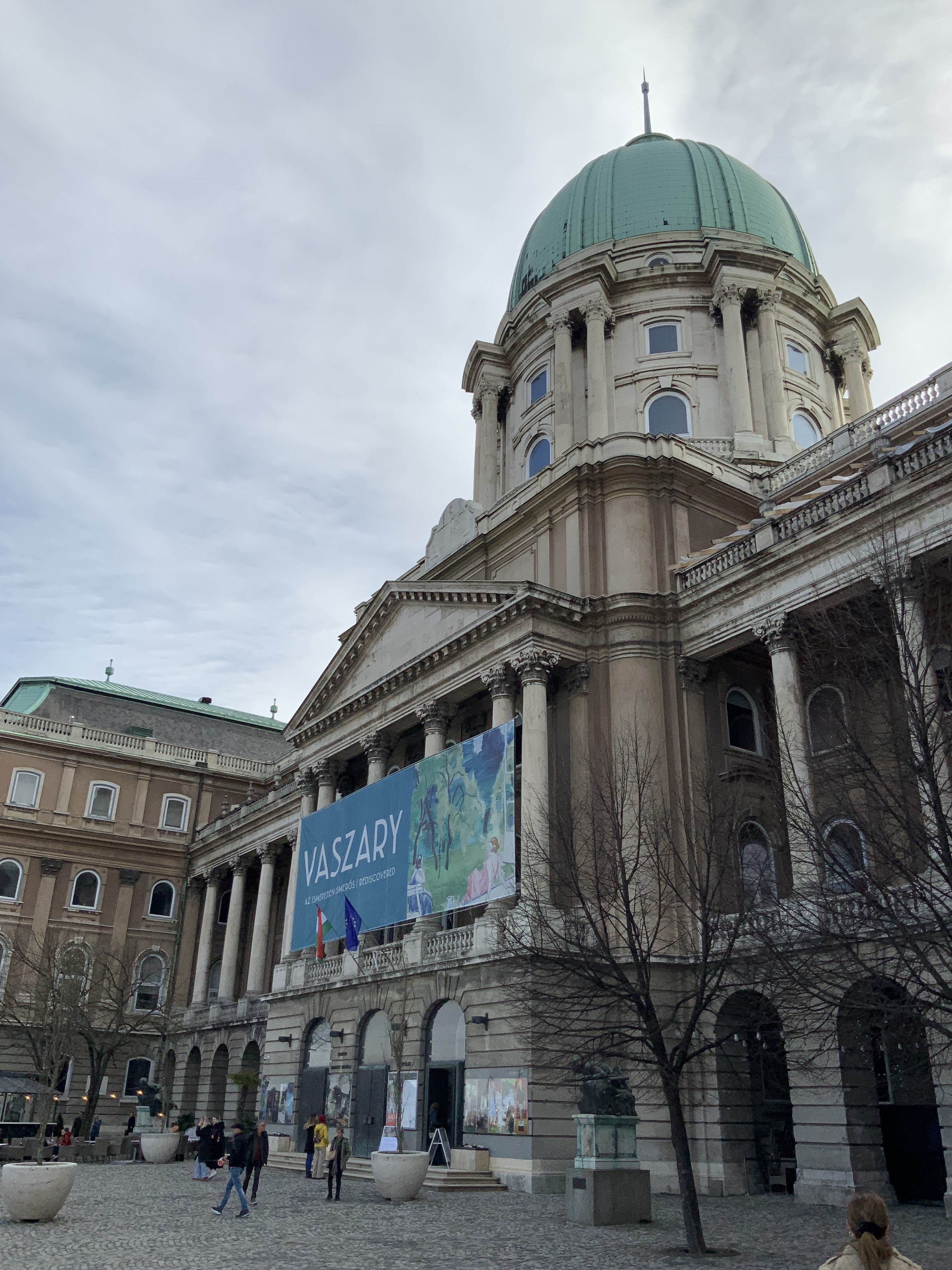
Buda Castle and art gallery

After a wander around the hilltop enjoying the sunlight, and then some lunch, I headed south along the ridge to Buda Castle, which hosts the national art gallery. The building and the space is monumental, with relatively little art actually displayed within. I was easily able to find and admire my favourite nineteenth-century things, and explored the dome cupola before heading back across town for some rest in Pest.

Tuesday, March 28, 2023

Balkans day 27: Romania

I’d wanted to start today with a trip to the National Village Museum, but when I set out it was raining heavily, so visiting a mostly-outdoors attraction didn’t seem very clever. Instead I turned to Ceausescu’s mansion. Located in a leafy area on the edge of the city centre, this building was only recently opened to the public.

Peacock mosaic in the swimming pool

Infamous golden bathroom

Spread over two floors, there are some excesses – like the golden bathroom above – but nothing like the scale of the Palace of Parliament. On the whole I thought it was a pretty nice rich person’s house. (Plus I’ve never liked it when people project someone’s moral or ethical failings onto their sense of taste; I’m sure people wouldn’t hesitate to declare Ludwig II of Bavaria’s grandiose construction projects to be sickening if he were a mass-murdering authoritarian like Ceausescu, but as it is they’re mostly considered quaint.) Scattered around the walls are photos of Ceausescu meeting various powerful figures over the years: Mao Zedong, Mobutu and Saddam Hussein, but also more than one US president. The guy liked his peacocks: art featuring peacocks is everywhere, and there are fifteen live peacocks around the grounds, who occasionally disturb the urban monotony with their yowling cries.

When I’d finished, it was still raining, but I didn’t want to miss the Village Museum, so I splashed across Herastrau Park to get there, and roamed around taking photos of interesting buildings while dodging school trips. Most of the buildings in the museum were physically transported there from their original locations across Romania – from the Banat to the Black Sea via Transylvania – during the twentieth century.

Cute house

Painted shutters

Church

By this point I was wet and hungry, so I got a late lunch – a coclinta, a type of pie from the Maramures region – and then settled in a coffee shop to charge my iPad. This Romanian sleeper I’m on may be the nicest sleeper yet – it’s very spacious, with a comfy pre-made bed and a power socket. As I write this we’re beginning to ascend into the Transylvanian mountains, and I’m watching the sun set outside my window. Onwards through the night!

Monday, March 27, 2023

Balkans day 26: Bucharest

Switching back into solo ambling plus coffee mode today. My first stop was the fantabulous eyesore that is Bucharest’s Palace of Parliament. Designed at Ceausescu’s bidding in the mid-1980s, it’s the world’s heaviest building.

Side of the Palace with blossoming cherry trees

I signed up for a tour, and after going through airport-like security we were shepherded around the building by a guide who rattled off facts and figures like a machinegun. I asked if it was true that the building was sinking into the ground, and she dismissed this as baseless. Everyone seemed rather on edge, and later we were told why: the president of Romania was visiting, and walked right past our tour.

Performance hall with 5-tonne crystal chandelier

State room

From the Palace I walked into town and had a tasty lunch in the courtyard of the Hanu’ lui Manuc restaurant (thanks to A. for the tip). This is right in the middle of the most lovely part of the city, and I wandered around taking photos of cool buildings for some time.

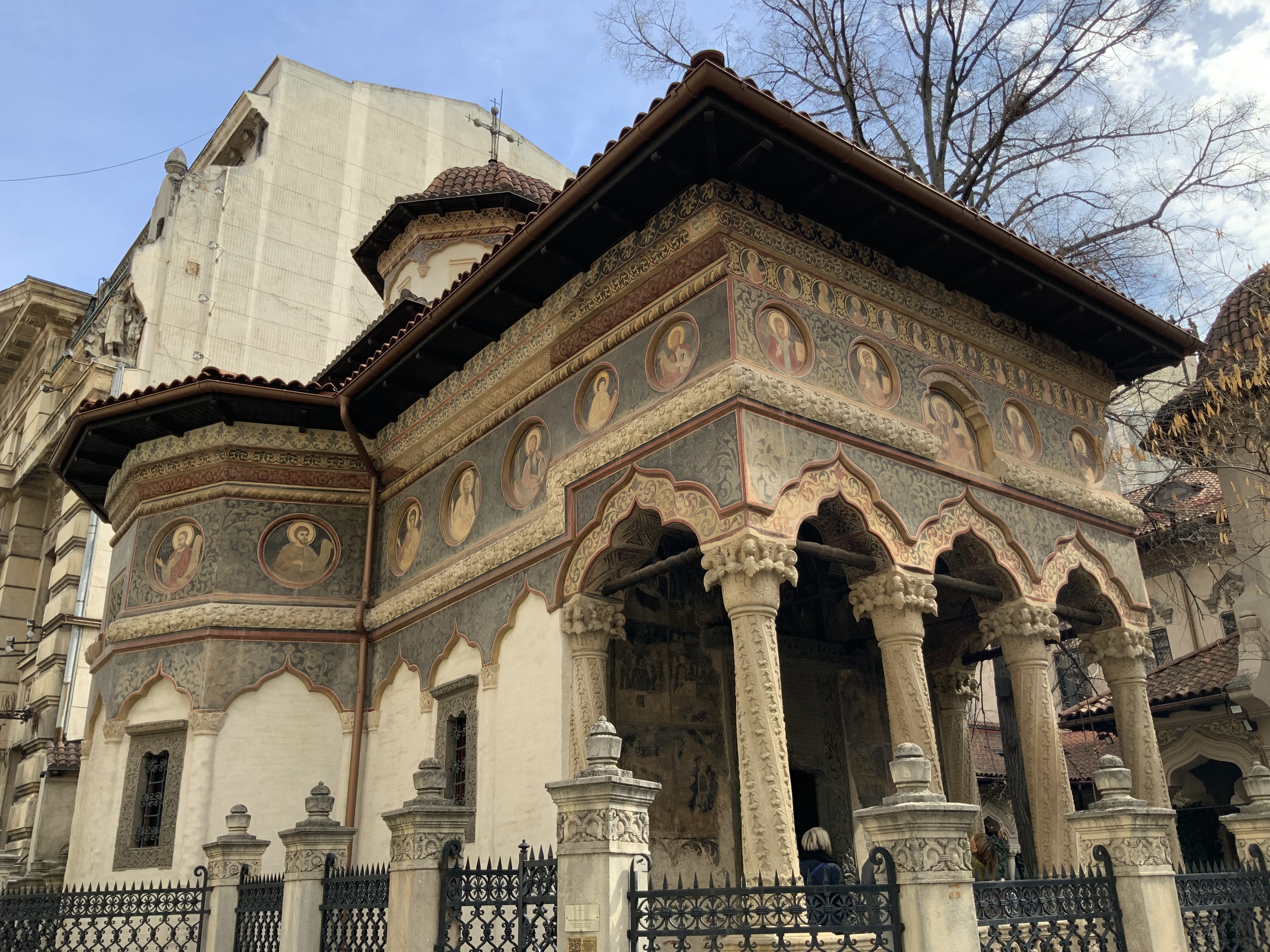
Stavropoleos church

Old university library with statue of Carol I

Romanian Athenaeum with Eminescu statue

Strangely, I learned on some Wikipedia-ing that the Romanian monarchy from the second half of the nineteenth century onwards were from “my” neck of the woods – they were Hohenzollerns, and Carol I and his son were born in Sigmaringen, near Konstanz. This only reinforces my suspicion that Germany’s most successful export product ever is royalty.

Sunday, March 26, 2023

Balkans day 25: Into Romania

Time, today, to leave Sofia and head north. Romania as a state isn’t straightforwardly in the Balkans: the usual definition is what’s south of the Danube and Sava, and that’s only a tiny proportion of the country, which I’m not visiting this time. But I’ve never been to the capital, Bucharest, so will spend a couple of days there before heading back home.

Countryside doing a good impression of the default XP desktop

That meant that today was a transit day. Another very early start, possibly the last of this trip, made more painful by Daylight Savings Time doing its thing. All told, it’s a ten-hour train trip from Sofia to Bucharest, split across two trains. The first is a grubby Bulgarian compartment train, which starts by winding north along the Iskar valley through the Balkan Mountains.

Goodbye Sofia

Crags north of Svoge

I share my compartment with two loud and smelly Bulgarian men who spend the journey watching videos on their phones with the sound on, laughing uproariously and scratching their crotches. Once through the mountains, the train bears right and crosses some peaceful countryside, dotted with a few villages. At Gorna Oryahovitsa the train splits, with my part turning north again towards Ruse, on the Danube. Gorna Oryahovitsa is within spitting distance of Veliko Tarnovo, the old capital of Bulgaria, but I don’t have any time to spare, as there’s only one Sofia-Bucharest itinerary per day, unfortunately. Similarly I’ve heard that Ruse is a nice town but I barely have time to spend my last few Bulgarian lev on supplies before hopping onto a Romanian DMU bound for Bucharest.

Ruse’s grand station frontage

Green Danube inlet north of Ruse

The train crosses the Danube on Europe’s longest steel bridge (2.5km) before stopping at Giurgiu for a passport check. Beyond here is nothing but empty fields for miles and miles, which the train slithers through at a snail’s pace, initially northwest, then swerving right onto the main line at Videse. Eventually we reach Bucharest’s bustling Gara de Nord, where this instalment draws to a close.

Saturday, March 25, 2023

Balkans day 24: Dragalevtsi

My last day in Sofia today – and a more peaceful adventure. We crossed the city by metro towards the mountain in the south, Vitosha, that looms over Sofia like a snow-clad giant. From there we got the bus into the foothills, and climbed by way of steep woodland trails to the Dragalevtsi monastery.

Stream in the woods near Dragalevtsi

It’s not a long trek to the monastery, but it’s a tremendously tranquil place. Some visitors were lighting candles by the church; others were content to sit and enjoy the quiet and the various cats that roam the place. On the church’s exterior are fifteenth-century frescoes, including one of my namesake saint.

Frescoes

Sleepy cat

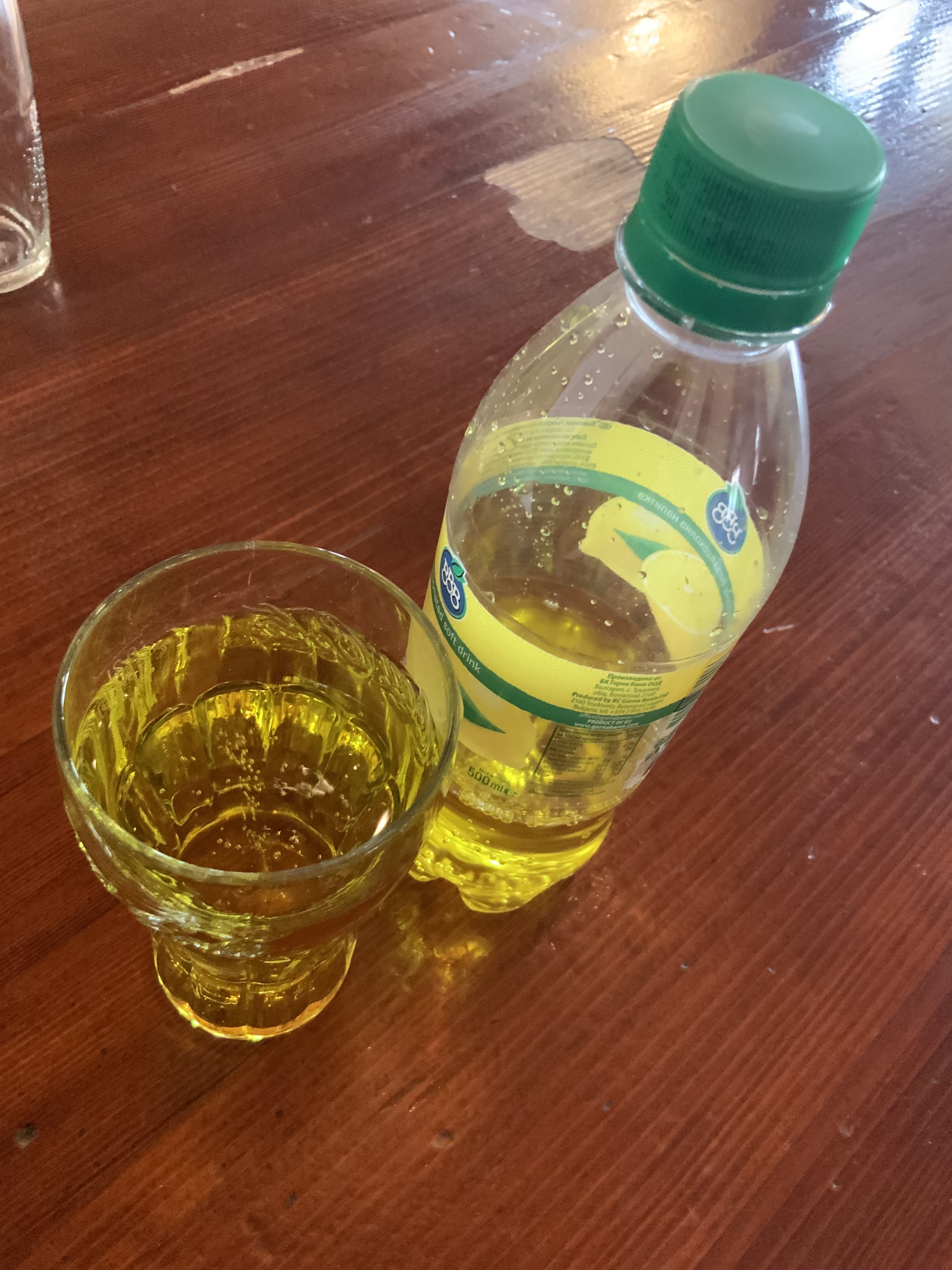
On our way back down the hill we stopped to enjoy an authentically Bulgarian meal at a lovely restaurant, together with this lemonade, which I’m told is also authentically Bulgarian, though in a different way.

Very yellow lemonade

Since there was still some daylight left, we headed across town to Boyana in the hope of seeing its tiny but exceptionally well-preserved church. The opening hours and the bus timetable were both on our side but, alas, the place was overrun by tour bus visitors with prebooked tickets, so we weren’t able to get in.

Boyana church exterior

After exploring the setting of the church for a little while, we hopped on another bus, which, after a winding tour of some of the city’s suburbs, took us back to the metro and home. Join me next time for another instalment of “George tries and fails to get into places of worship”!

Friday, March 24, 2023

Balkans day 23: Return to Sofia

Especially after a hectic day like yesterday, it felt good to be escaping the bustling metropolis that is Istanbul and return to Sofia, which comes across as cosy by comparison. This time I knew the drill, and was able to get a bit of sleep both before and after the border formalities, which in this direction take place at an even more punishing 2-3am. In Sofia it is warm, and the trees are starting to blossom.

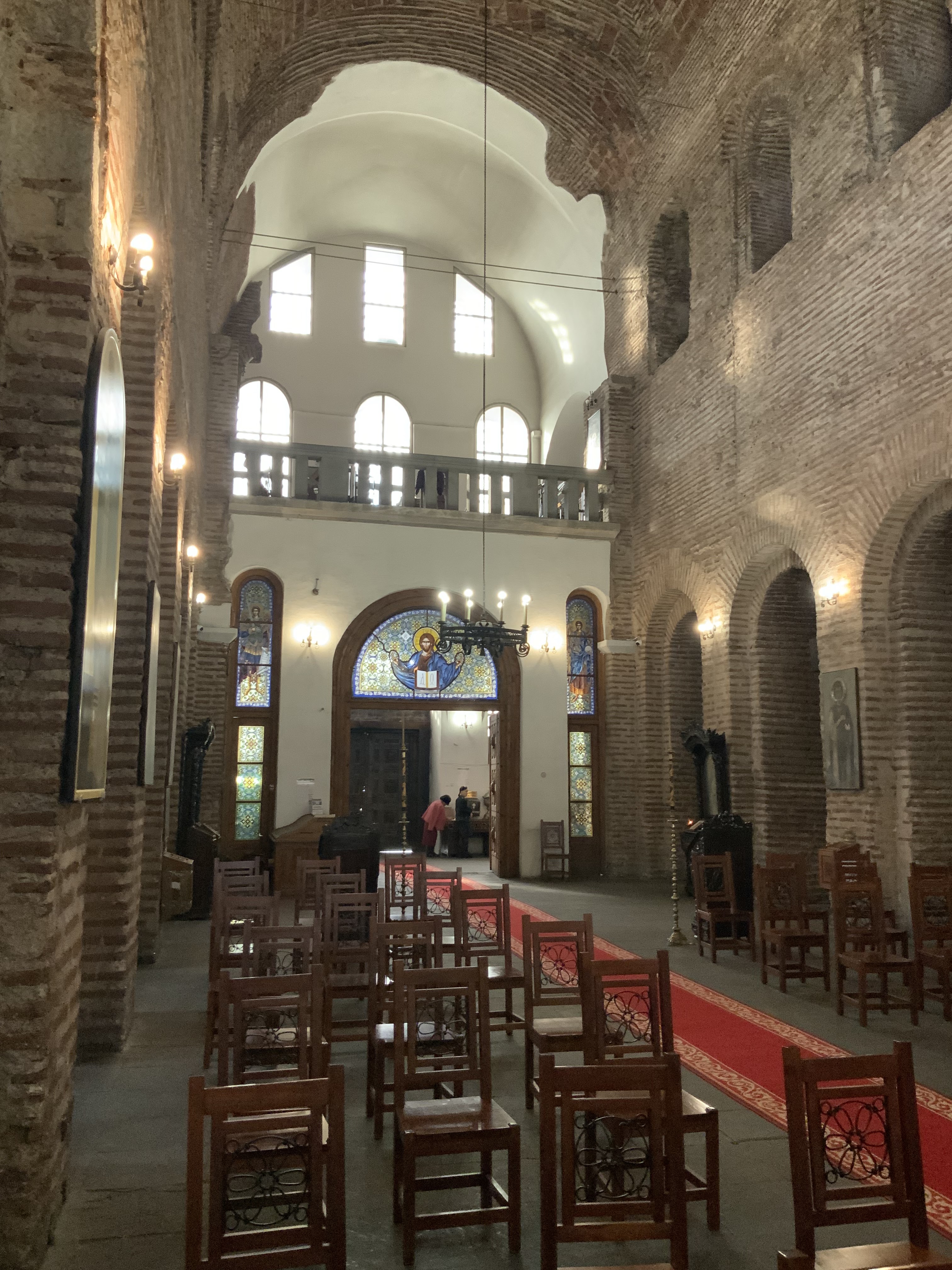
In the afternoon, inspired by my failure to go to the Hagia Sophia in Istanbul, B. took me to see Sofia’s own Saint Sophia Church. It’s not a hulking monstrosity like its Istanbul counterpart, but a modest, cool brick building that has weathered many changes over the centuries since a church was first constructed here in the fourth century.

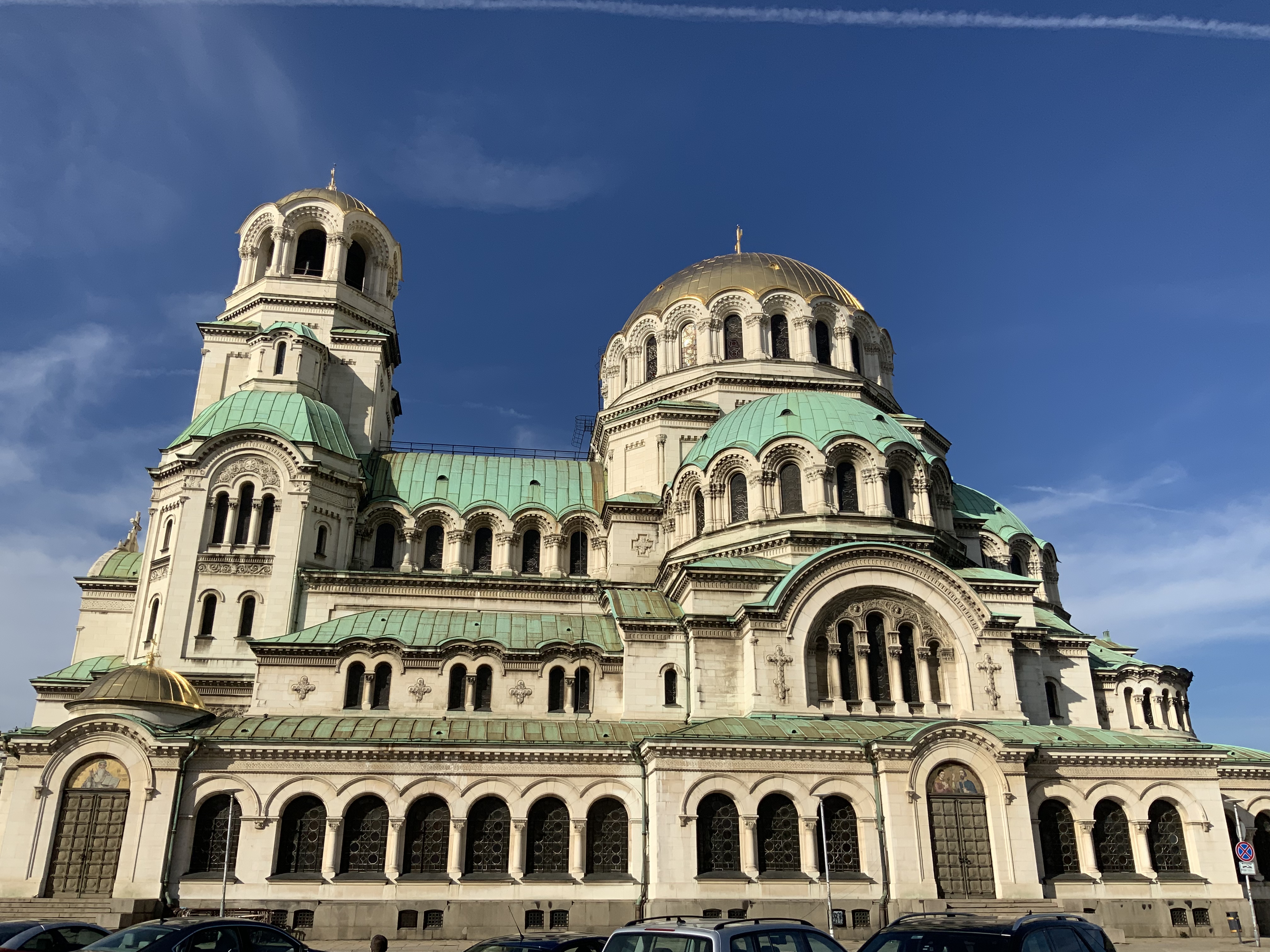
No, not this one! This is the Alexander Nevsky Cathedral

Nave of Saint Sophia church

Under the church is an ancient crypt containing several layers of tombs and mosaic floors.

4th-century tomb with early Christian floral design

Reconstructed mosaic floor

Thursday, March 23, 2023

Balkans day 22: Istanbul

Having rested and recharged overnight, today was a day of zooming round Istanbul like a maniac. First stop was the Theodosius Cistern, a huge underground space that plays host to a series of lightshows illustrating the city’s history.

Theodosius Cistern

Within easy walking distance of here is the enormous, mazelike, and intimidating central bazaar. I let myself be carried by the crowds in, around, and back out again while absorbing as much of the atmosphere as I could take.

Central Bazaar

Then it was onto a tram, across the Golden Horn, and up the hill to take in views from the Galata Tower.

City rooftops

Back down the hill, past the fishermen on the bridge, and through old Sirkeci station, I hopped on another Marmaray, this time under the Bosphorus itself to the Asian side of the city, for a coffee and a stroll along the waterfront.

Maiden’s Tower, ship, and Topkapi Palace in Europe

Finally – since the Blue Mosque was denied to me, and my attempt to visit the Hagia Sophia failed – I made my way through a bustling commercial district to the Süleymaniye Mosque, commissioned by Suleiman the Magnificent and designed by Sinan, the architect who probably did more to shape Constantinople/Istanbul than anyone else. It also features Suleiman’s tomb in the mosque grounds.

Dome of Süleymaniye Mosque

After all that, it’s now time to leave Istanbul. I’ve never been to a city where the price differentials are so steep: today’s lunch cost literally a tenth of the previous day’s lunch, despite being very similar. There’s some serious tourist-gouging going on here. I’m also not a fan of the many dudes who hang around on the street and ask you where you’re from, presumably trying to make some sort of money out of you. Relatedly, it’s weird how about two thirds of the people you see out and about are men, often hanging around in hypermasculine-looking groups, even in the sort of service jobs I’m more used to seeing staffed by women. But the city as a whole has left an impression. Istanbul – and Turkey in general – deserves much more time than I’ve been able to give it on this visit. (It’s the first time I’ve “properly” visited the country; previously I’d only changed planes here.)