Showing posts with label travel. Show all posts

Thursday, February 12, 2026

Troutworthy's Travel Blog: Lascaux (Art imitates art)

It was 11th September 1940. Exactly sixty-one years later, two planes would slam into the World Trade Center, and a third into the Pentagon, killing thousands and leading to the deaths of millions more. But on this day, a year before construction on the Pentagon began, although dark things were afoot in Vichy France, all was quiet in the Vézère Valley, where, outside the village of Montignac, eighteen-year-old Marcel Ravidat was walking his dog in the early autumn sun.


A year earlier, Ravidat had attempted to enlist with the French Army, but was turned away on account of his youth. If not for that accident of history, one of the greatest discoveries in the study of prehistory may never have been made at all. Pursuing a rabbit, Ravidat's dog Robot, a real organic dog named after the artificial organic workers in Karel Čapek's 1920 play R.U.R., was nosing around the base of an old, uprooted oak tree when it lost its footing, slipped and tumbled into a newly unearthed crevasse. Initially alarmed, Marcel Ravidat's concern turned to curiosity after he managed to retrieve Robot unharmed and in the process came to realize that the rabbit hole went very deep indeed.


Ravidat returned with three teenage friends and clambered down into the cave, which, they soon discovered, was filled with vibrant depictions of animals. In a manner reminiscent of the Famous Five, at first they had fantasized that they might have uncovered a legendary secret passage to Lascaux Manor, but they quickly came to realize that what they had on their hands was something altogether more ancient. They were put in touch with the priest and prehistorian Henri Breuil, who upon visiting the site on 21st September was able to establish that these artworks were thousands of years old. And that, in a nutshell, is the story of the discovery of the caves of Lascaux.


Except it isn't. The above story never happened. I lied to you.


The discovery of Lascaux didn't take place on the eleventh of September, but I liked the idea of juxtaposing this pastoral scene with 9/11. (Funnily enough, 11th September 1941 indeed seems to be the day ground was broken in the construction of the Pentagon.) I have no idea whether it was a sunny day, or whether the uprooted tree was an oak tree, though both things might have been true. The story of Ravidat trying and failing to join the Army is also one I made up wholesale. And these are just the aspects I intentionally misrepresented; I may well have got more wrong by accident.


Some of the stranger aspects of the story are true, as far as I can tell. The dog was indeed called Robot, although the English Wikipedia article mysteriously fails to mention this important fact. Why the dog was called Robot may have had something to do with Rossum and his Universal Robots, directly or indirectly, or it may not; I have no evidence of any direct connection. Breuil was indeed a priest, although by and large the era in which amateur antiquarian clergymen dominated the European intellectual scene was otherwise over by 1940.


Still other aspects of the story are untrue, but not made up by me. The idea that Robot fell into the cave is, according to Wikipedia, an embellishment made up by Ravidat himself. This is supported by the more extensive version of the story in Gregory Curtis's The Cave Painters (p88), which also makes no mention of the rabbit found in other accounts. Meanwhile, the actual date of the events described above is not clear: the Wikipedia page at least strongly implies that it was 12th September (not 11th), but this site says it was the 8th. But that site also says Ravidat was 17 at the time, whereas we know that his date of birth was 16th May 1922, in which case he must have been 18.


Misinformation also surrounds one of Ravidat's three human companions, Simon Coencas, a Jewish refugee who'd only moved to Montignac with his family in June of the same year. Less than a week after the meeting with Breuil, a German-led law enforced by the Vichy regime required all Jews to register, which they duly did, travelling to Paris for this purpose. In 1942 the whole family was arrested. This page writes of "Simon and his family, deported [plural agreement] to Auschwitz". But this page makes it clear that Simon and his sister, by virtue of their young age, were spared the fate of the rest of the family, who, like so many, did not survive Auschwitz. 


Simon Coencas died on 2nd February 2020. Just over six years later, on 11th February 2026, my early morning bus crosses the river Vézère, its waters a turbulent chocolate brown, well above the level of the riverside path. After an avocado toast in town (well, I already own a flat), I trudge out to the site of Lascaux IV. It's an ugly concrete building, better set up for coachloads than it is for the lone Brit in February who, it turns out, is the only person signed up for the English-language tour that morning. I think my guide is recovering from a cold. Following a spiel about the discovery of Lascaux – repeating the "dog fell in" trope – she produces a key and unlocks the cave itself.


It's easy to see how the teenagers, and even Abbé Breuil himself, would have been impressed. The entrance area, the Bull's Chamber, is a spacious dome full of enormous bulls in the three colours of Lascaux: black (manganese oxide), ochre and red (iron oxide). Beyond it is a corridor-like space whose ceiling is covered in horses. It's equally easy to see why Breuil called the cave the "Sistine Chapel of Prehistory". Outside her script, my guide isn't very talkative, but silent wonder suits me too. I stride on, almost alone in this legendary space, through areas named the Nave and the Apse, past an image of two bulls facing away from one another, partly overlapping, demonstrating that Cro-Magnons twenty thousand years ago had an understanding of the art of perspective.


This, too, dear reader, is a lie. Well, sort of. What I called "the cave itself" isn't the cave itself, in the context of Lascaux IV, but rather an impressively precise reconstruction. Sixteen pixels per millimetre, according to my guide. Other than a few black connecting corridors to better funnel the hordes of gawkers onwards, it is picture perfect. Not olfactorily perfect, though: my guide, who has visited the original, tells me that the smell of the true Lascaux cave is really quite disgusting. They could easily recreate it, she says, but no one particularly wanted to do so.


If my mendacity hasn't driven you away yet, thanks! And sorry. I've just become fascinated with replicas and replication of all kinds. In 2025, at about this time of year, I visited Warsaw, whose baroque castle is an elaborate 1970s reconstruction (by a Communist government, no less), and Vilnius, whose Palace of the Grand Dukes has even less claim to authenticity. History is clearly important to people! The original Lascaux cave had to be closed to the public in 1963, once it became clear that the collective exhalations of a million visitors had a deleterious effect on the object of their awe. Twenty years of tourism threatened to destroy what had lain undisturbed for twenty thousand.


And so, in Warsaw, in Vilnius, in Montignac, around the world, people throng to visit impressive fakes. Lascaux IV is the third replica; Lascaux II, the first replica, is still popular with older generations who visited it in their youth, and Lascaux III is a sort of peregrinatory Baba Yaga's hut of a cave, hopping around the world to bring the replica to the people. But perhaps "fake" is unfair: people seem happy enough, in many such cases, to accept the replica as the real thing. The Ship of Theseus, but if the whole ship had been blown to smithereens by a German U-Boot and a replica had been built in the Cold War period. 


With written histories, meanwhile, it's harder to tell real from replica. Perhaps this is because any history is a representation of the events it purports to narrate, rather than the events themselves: the map is not the territory. In this sense, history is replica by definition, and I've been writing recently, following Hayden White, about how it must take narrative form, which constrains it to share some of the properties of fiction. Seen this way, the replica-hood of history is virtually a trivial, necessary property. And yet clever people have felt the need, over and over again, to reassert the distinction: in linguistics, for instance, Ernst Pulgram's Real Proto-Indo-European versus Reconstructed Proto-Indo-European. This suggests that other clever people often fall into the trap of ignoring it, and of mistaking the replica for the original.


The cave painters of Lascaux must have been in a position to make the distinction, since they were capable of representation. The paintings of bulls in Lascaux are not bulls: ceci n'est pas un taureau. More generally, evidence of symbolic behaviour is everywhere in Lascaux, even if we don't know what the signified is in many cases: gate-like geometric structures, series of dots. In that sense, Lascaux IV is a replica of a replica, the main difference between the two processes being only that the second replication had a much higher degree of verisimilitude than the first.


(I find it interesting that this page refers to the four teenage discoverers as "inventeurs"; the related English word "inventors" is one we wouldn't use in this context, as it implies creation from scratch. But we can say something like "Edison discovered the electric lightbulb", as if he were out walking one day when his dog dug it up from under an uprooted tree in the Dordogne. Weird.)


Younger me was fiercely against intentionally deceiving anyone, ever, for any reason. So I'd get in trouble for saying things like (to my then girlfriend) "You're the second most beautiful person I've ever met". Older me thinks that, an age in which yet more clever people are being taken in by "AI", perhaps there's value in fakers like Alan Sokal and Jonas Bendiksen, as long as they reveal themselves – if only because their work reminds people of the difference between real and replica, and of the fact that the difference between types of replica largely boils down to creator intentions.

Wednesday, February 11, 2026

Troutworthy's Travel Blog: Platform 37

The rain doesn't so much lash at the window as slump resignedly against it before sliding hopelessly to the ground. Alongside the track I see an unbroken sequence of muddy fields, flooded copses, flooded fields, muddy copses. It's February, I'm in Burgundy, and the train is going at a snail's pace. Across from me, a slender, grey-haired, taut-looking Frenchman's hacking coughs provide continuous percussion.


This is, of course, the first day of my week of holiday in France. I'd been happy to rely on a clockwork eight-minute connection in Zurich, but for all my connections in France I'd left plenty of time. Except one: this regional train from Dijon to Nevers, which has to arrive on time in order for me to make a six-minute connection. It would have been faster and safer to go all the way from Zurich to Paris, and then out to Vierzon from there, but when booking I'd wanted to do something more adventurous. I'd challenged the spider's-web governing logic of French railways, where all routes lead to the Île-de-France, and for my temerity I have been punished. Outside the village of Cheilly-les-Maranges my train ground to a halt, and eventually, after what seemed like a eternity, with no communication from the train staff, it began to crawl along again. But this time so slowly that it feels like there's a man with a red flag walking in front of it.


Thus far off the beaten track, perhaps I've wandered into a pocket dimension of kismet and strange coincidences. An hour ago, this train passed through the town of Beaune. Just yesterday, following a tip from my father, I'd picked up a book by Karl-Markus Gauss called Im Wald der Metropole ("In the forest of metropolises"), and discovered that the first section of the first chapter took place in Beaune. When I saw that I'd be passing through the town, I'd decided to read the chapter. I was still reading it when the train came to a stop, and kept reading it while waiting for the train to pull itself up by its bootstraps. Occasionally I try to check my connections online, but it is futile: this part of France no more has the internet than it has a functioning rail system.


Gauss's chapter takes us from the grimace of a man he encountered in Beaune, to the grimace of a bust by the eighteenth-century sculptor Messerschmidt that now resides in Schloss Belvedere in Vienna (which, coincidentally, I also visited for the first time last month), to another bust by the same sculptor of a prince whose advisor was the African-born Angelo Soliman, to Soliman's daughter's husband's second wife's son Ernst Feuchtersleben, a pioneer of matters psychosomatic, and finally to a bar in Vienna where Messerschmidt had lived. A fine chain of digressions. 


There was something Kafkaesque about experiencing this meandering narrative while going nowhere, though. I should have sensed it as soon as I'd got off the train in Dijon, where there is a fine landscaped garden complete with natural history museum right next to the station. The platforms, though, are labelled A, C, D, E, F, G, H, I, J, 3, and 37, and my train via Beaune departed from the latter. It's three minutes' walk from the station building, and guests are advised to follow the blue line painted on the ground through this modern-day not-quite-labyrinth. In a station where platforms have letters, the best adventures start at platform 37.


My train eventually picked up speed again, and after stopping at Montchanin it seemed to have gained a new lease of life, albeit with a forty-minute delay. At this point I'd more or less given up hope of making it to my destination on the same night, since I was on track to miss not only my fecklessly optimistic six-minute connection but also the backup train too. But, wonder of wonders, the latter was also slightly delayed, and so I was able to leap across the platform at Nevers. The next and final train – an elegant intercity from Vierzon – was even later, pulling in to its last stop with over an hour's delay. It was after midnight, and by this point the afternoon's rain had regressed through the stages of grief from depression to anger: now it flung itself assertively in my face as I sprinted the last few metres to the Grand Hotel Terminus. After thirty uncertain seconds at the intercom, I was let inside.

Friday, February 14, 2025

Troutworthy's Travel Blog: Kaunas

The Neris flows into the Nemunas at sunset.

More than twenty years ago, as an eighteen-year-old in 2003, I followed a lush carpet of green grass through the trees and into a clearing. Birds were singing, and the early autumn sun shone upon the scene with barely a cloud in the sky. In the centre of that clearing was a squat, red-brick cuboid that nature was doing its best to reclaim.

That building was a gas chamber where hundreds had been murdered, and I was a visitor at what remained of Dachau concentration camp.

It seems to be my luck that I get to visit the most nightmarish places on earth on the most achingly beautiful days imaginable. Today, after a winding bus journey to an unremarkable suburb of Kaunas, I make my way through a narrow concrete underpass to the city's Ninth Fort.

The fort.

Built as part of a system of fortifications in the early twentieth century, the site proved utterly useless for this purpose, and was taken by the Soviets within a couple of days. Today it is best known for being a prison and site of mass extermination of Jews during the Nazi occupation, the most horrifying of all such sites within Lithuania, its centripetal death-pull drawing in the doomed from as far away as France and Austria.

The fort sits atop a gentle rise. Though it's a low, ugly building, the site is monumental: the visitor centre, car parks, memorials, and the fort itself are laid out on a swathe of grassland punctuated by old, silent trees. The sky is a limpid blue, though there is a little mist on the grass. The focal point is not the fort itself but the dreadful, breathtaking memorial sculpture by Ambraziūnas, evoking something between a ruined power station and the clawed, desperate hands of a titanic buried humanoid, reaching a hundred feet up into that sky as if trying to grasp the winter sun. Perhaps an avatar of empathy or suchlike, whose time has passed.

Memorial.

The horror of the place can't really be put into words. Tens of thousands died here, this we know; but numbers also seem unable to capture what the place connotes (“Ninth Fort”, just one fort among many). When they burned the bodies, the heat was so fierce that glass began to melt. In one of the cells there's an exhibition where several people who narrowly escaped genocides across the world are quoted as saying the same thing: when you emerge from such a place, it's not always clear whether you really survived or are instead experiencing a different form of death.

The Japanese vice-consul at the time, Chiune Sugihara, helped thousands of Jews flee Lithuania in 1940 by writing exit visas for them, in defiance of protocol. Reportedly, he was still writing them until the moment his train departed (the consulate having been closed down). Even a bureaucrat can be a hero. Would I have the backbone to do something like this, if in a position to? More likely I'd take to Twitter to register my displeasure in a dry QT – if that. I hope that's not the case, obviously, but the atmosphere of this place isn't conducive to positivity.

After a while I head back into town. Kaunas is Lithuania's second city, but the small, quiet Old Town doesn't make it feel like a settlement with a population of three hundred thousand. I realize later that the heart of the modern city is elsewhere. Can't blame its inhabitants for wanting a clean break from the past. Unlike Vilnius, Kaunas is fairly geographically central in Lithuania. It lies at the confluence of the rivers Neris and Nemunas. These two rivers have quite different characters: the Neris brings hundreds of ice floes from Belarus via Vilnius, depositing them in the more sluggish Nemunas for transport to the Baltic. I walk to the end of the long spit of land that separates them and take in the view.

Thursday, February 13, 2025

Troutworthy's Trakai Travel Blog

On my second day in Vilnius, I head out to Trakai, a small town at the end of a branch line through the woods. The path to my destination leads around the edge of a lake, which, it being -9 degrees C, is completely frozen over. I'm thankful for the thick layer of blubber that I, like a polar bear, very deliberately and intentionally accumulated over the winter.

Trakai castle.

Trakai is most notable for its two castles. The more impressive of these was built by Vytautas on an island, and completed in 1409, the year before the battle of Grunwald/Tannenberg. Vytautas himself has as much claim as anyone to be the legendary founder of Lithuania, though he never ruled it independently, but rather as a vassal, at least nominally, of the Polish king Jagiełło. The twist in the tale is that the two were cousins: Jagiełło, born Jogaila, was the son of the Lithuanian Grand Duke Algirdas, and Vytautas the son of his brother Kęstutis. Although not always on good terms, the two managed to put their differences aside long enough to stick it to the Teutonic Knights at Grunwald. The Teutonic connections don't end there: in 1377 the Order besieged an early incarnation of the castle, and in the years before Grunwald – during a period of peace – one of the Order's master masons, Radike, was supposedly involved in supervising the final construction works. Right now, with the lake frozen over, the situation puts me in mind of Alexander Nevsky's 1242 Battle on the Ice, which also didn't end well for the Teutonic Knights.

The castle is approached over a long bridge, which reminds me of the island of Mainau on Lake Constance. Surprisingly, Konstanz, too, features in the history of Lithuania and the Knights: the Council of Konstanz took place shortly after Grunwald, and the Order, trying desperately to rebuild, were active in petitioning Emperor Sigismund for various concessions against Poland-Lithuania. But Sigismund was more interested in resolving the crisis in the papacy, and Jagiełło's kingdom ended up with the better deal. The long overland journey of the Order's delegation from Lithuania to Konstanz must have been similar to mine, though perhaps slower and without quite as much free wifi.

Inner courtyard of the main tower.

The castle fell into disrepair in the eighteenth and nineteenth centuries, and was reconstructed in the twentieth. Its collections range from the random-but-elegant (an early glassware collection) to the purely random (a room full of nineteenth-century tobacco pipes), but there are also exhibitions about the castle's history, and two imposing new stained-glass windows depicting Vytautas and his father Kęstutis.

Vytautas.

As ever, it's tricky to distinguish between original and reconstruction, between “true facts” and Romantic imaginings, especially on an empty stomach. There's no cafe at the castle, and by the end of my visit I'm undercaffeinated and a little hungry. The latter problem is solvable by virtue of a food van sitting at the town end of the wooden bridge from the castle, selling what I perceive to be Cornish pasties. These, though, are a traditional thing for Karaim/Karaites to eat, one of Lithuania's nationally-recognized ethnic minorities, who've been dwelling in Trakai since before Grunwald. There were Tatars here, too, apparently much-feared mercenaries fighting on the Polish-Lithuanian side, though in the battle itself they ended up not playing much of a role.

My neighbour Totorių.

After a little exploration of Trakai town, it's time to head back to Vilnius. I make my way to the Museum of Occupations, housed in the grand, intimidating former KGB building. Not a cheery place, and I'll spare you the details. During World War 2, Lithuania was occupied by the Soviets, then the Germans, then the Soviets again in the space of a few years, with neither side behaving generously towards the locals. And thinking back to the days of Trakai Island Castle and Grunwald, ultimately, the same dynamics are at work: for Lithuania and places like it, independence and prosperity – often even survival – was only to be achieved by playing off distant, powerful entities against each other, whether that be the Teutonic Order and Poland (at the turn of the fifteenth century), the Emperor and the church (at the Council of Konstanz), the Nazis and the Soviets (during the war), and now Brussels (or Washington?) and Moscow.

This last weekend, the three Baltic states ceremonially severed their power grid from that of Russia. After 24 hours of being allowed to stand unaided, like precocious, tottering toddlers, the network was connected to that of the EU: time to hold Daddy's hand again. The official line is that this arrangement drastically reduces the likelihood of malign foreign interference, certainly a concern, again, since February 2022. A. is cautious, though: Russian energy was cheap, and the Baltic governments have been tight-lipped about the costs of this transition and who will bear them.

Wednesday, February 12, 2025

Troutworthy's Travel Blog: Vilnius

Vilnius impresses me almost from the start. The grand entrance hall of the station draws your eyes upwards. When I arrive, a string quartet is playing in this space, and people have stopped to listen. It's dark by now, but buildings are well lit, and I'm able to see a lot of the city from the car. We drive down narrow cobbled streets and under arches. This part of town was transformed into a ghetto by the Germans during the war, simply by erecting gates across the mouths of some of these streets. Lithuanian Jews suffered horrifically during the war.

The architecture is a beautiful mixture, with quite a lot of baroque and also nineteenth-century eclecticism. The centre is dominated by three buildings: the neoclassical archcathedral, the recently reconstructed Palace of the Grand Dukes, and, rising above both of them, the Gediminas Tower.

Tower.

This tower sits on a hill that was constructed hundreds of years ago, and is all that remains of a larger fortification. In times past the hill was covered in trees, but more recently these have all been removed, and at the same time parts of the hill have started to collapse, needing to be patched up with concrete or metal struts. The sight puts me in mind of the hapless partygoer who wakes up on the sofa after a party to find that his erstwhile friends have shaved his head. But the tower itself is cute, and from the top of it there's a magnificent view over the city, speckled with snow.

View over Vilnius, looking towards the university.

The university, established in 1579, dominates its quarter of the old town, and its elderly buildings have been kept in fine condition: A. had taken me to see the frescoes and ceiling paintings the previous evening. In the afternoon, after a lunch of “zeppelins”, we visit the Palace of the Grand Dukes, a museum that, like the castle in Warsaw, is almost completely reconstructed, with the exception of the extensive foundations visible in the basement. Today it's mostly a museum, with parts of it serving for state functions. I can read here about Gediminas himself, along with Mindaugas, Algirdas, Kęstutis, Vytautas, Jogaila and others who play a role in the book I'm reading about the last years of the Teutonic Knights. A sense of history is clearly important to people, and even more so if it's accompanied by the appropriate pomp and circumstance.

Tuesday, February 11, 2025

Troutworthy's Travel Blog: Into Lithuania

A representative view from the train.

A bright and early start: there's only one connection from Warsaw to Vilnius each day, and it leaves at 7:55am. My conveyance is a comfortable, spacious loco-hauled beast, the brontosaurus of trains. Though stopping regularly, it powers along to Białystok in a couple of hours, but then stops there for over half an hour (“for technical reasons”, as the website has it). After that, its progress northward is notably slower, and it repeats its lengthy stop at Suwałki. But nothing can stop it as it lumbers towards and across the border. The scenery is much like what I remember from the Riga-Valga train: plains, mostly forests (alternating evergreen and birch), some farmland, occasional marshes, and even a few hills near Suwałki. I've been reading about the Battle of Grunwald/Tannenberg, a significant defeat for the Teutonic Knights against the combined forces of Poland and Lithuania in 1410, and it occurs to me that it must be around here somewhere, but when I check my maps it turns out that we're far too far east for that (close to Belarus).

I've been to Lithuania before, but only on a technicality: when I was travelling back by coach from Riga to Warsaw in 2019, I stepped off at Šiauliai bus station to stretch my legs for about twenty seconds. My quest to visit all the countries of Europe before my fortieth birthday will end in respectable failure: all the remaining countries – Russia, Belarus, Ukraine and Cyprus – are currently out of reach for various reasons. So this trip to Lithuania is intended to set the record straight by doing (more) justice to the country.

It feels absurd to be winding my watch forward an hour while trundling through the woods. It strikes me that flying is the ultimate form of transport for the nation-state, allowing one to imagine a clear discontinuity between point of origin and point of arrival. Borders, paradoxically, are a lot more concrete and well-defined when you don't have to actually cross them on the ground.

Mockava.

A through train is not possible due to the switch to broad gauge, and so we have to stop at Mockava, whose station is a nowhere place in the forest. The change is easy – from one side of the island platform to the other – though it's a bit chilly. After a while the Lithuanian train comes in, a DMU, more of an allosaurus.

Lithuanian train.

Both trains are warm and welcoming inside, with power sockets, and catering. This one even has wifi, and is in more of a hurry. After Kaunas, it runs non-stop for over an hour before reaching Vilnius. Here I'm met by the kind and indefatigable A., who takes me in his car for a quick tour of the capital of Lithuania – but that's the topic of another blog post.

Monday, February 10, 2025

Troutworthy's Travel Blog: Warsaw

Warsaw is bitterly cold when I reach it; not surprising for February, I guess. Emerging groggily from a nice warm sleeper train on which I had had only a small amount of sleep, it takes me a while to orient myself enough to escape the catacombs of the city's central station. Eventually I find myself in the basement of some sort of corporate tower. Having played a lot of Cyberpunk 2077 recently (itself developed in Poland), I wonder if this is the point at which I get attacked by killer robots.

I've only been to Warsaw once before, in passing, when I was returning from Estonia. I'd only seen this area of the city, and only in darkness. It didn't strike me then as a lovely place, and, upon seeing it in sunlight, my first impression is confirmed: rectangles of Communist concrete between which a newer growth of capitalist steel-and-glass towers has taken root. Still, the area around stations is often depressing, so I hop on a tram and head to the old town.

Warsaw old town square.

It's still very quiet at 10am. Everyone's probably still in bed, or at church, or both (after all, many services can be streamed nowadays). That gives me the chance to observe the old town uninterrupted. Some of it is more toytown than old town: buildings of different heights, but still apparently built from the same blocks. The comparison to Krakow, where I was last year, is never far from my mind, but that's an unfair one: Warsaw suffered far worse in World War 2, especially after the Uprising in 1944, and almost everything here is reconstructed.

After getting some coffee and eggs, I roam the streets for a while, through the palace gardens, past churches and an unfathomably large theatre. Eventually I buy a ticket to visit the castle, and, grabbing an audioguide, am led through a series of opulent rooms decorated as they were in the time of King Stanisław August, the eighteenth century.

Throne.

Some of the furnishings are later gifts that date to the period, and some of the paintings were saved early in the war, but the reconstruction is still topmost on my mind: the whole building dates to the 1970s, when the Communist government (with understandable reluctance) agreed to rebuild it brick by brick, the original castle having been “blown up” by the Nazis in 1944.

It's interesting to evaluate the Warsaw Uprising from a present-day standpoint. Most today (especially since February 2022) would probably agree that violence in self-defence is justified, the Sermon on the Mount notwithstanding. Justified violence in the interest of liberation from tyranny is a popular position too, and the Nazi occupation was as straightforwardly tyrannical as it's possible for any actually existing force to be. Yet the outcome was catastrophic: the uprising failed (a fact for which many blame Stalin, apparently) and the Nazi military retaliation led to civilian casualties numbering in the five figures, as well as the wholesale destruction of the city centre. Nor were the resistance fighters angels: some Jewish fighters were murdered by antisemites who were nominally on the same side. The fact that Stalin's forces drove off the Nazis less than a year later makes the whole thing seem particularly futile – though of course that's the magic of hindsight. Was it worth it? Not my place to judge.

There was more I wanted to see, but sleepiness means that I have to retire early. Today I'm on the rails again, heading north.

Thursday, April 04, 2024

Troutworthy's Travel Blog: Up and round

I leave Helsinki on the evening of the second, boarding a train that is bound for Kolari, in the far north. Kolari itself is the northernmost tip of the Finnish passenger rail network, but I'm not going that far: Tornio, on the estuary of the river Torne – the river that defines the Swedish-Finnish border for hundreds of kilometers – is my destination. Still, it's the furthest north I've ever been in my life, narrowly beating out Akureyri, in Iceland.

The Finnish night trains are well equipped. Like other countries of the former Russian Empire, Finland's railways are built to five-foot gauge, which allows these trains to be enormous beasts of burden. I'm in a two-bunk compartment on the lower level, effectively meaning that four people can sleep stacked vertically. The trains are new and very clean, with card-locked compartment doors. I don't sleep very well, perhaps because it's odd to be travelling so far north when I'll be turning round and heading south again the next day.

Tornio doesn't have much of a station – just a platform with a couple of signs on it. When I arrive, the sun is shining, but it's icicles-in-the-beard temperature. In principle, a branch to the southwest means that trains can travel between Tornio and its adjacent Swedish twin city, Haparanda, on the other side of the Torne, albeit with a break of gauge. In practice, no passenger trains currently make the trip, and so it's a trek of a little under five kilometers to Haparanda station.

The frozen river Torne.

This part of Tornio is pretty industrial, and the black ice on roads and pavements is treacherous, but I manage to find my way through via a surprisingly nice little bakery and café. A long bridge connects Tornio island – where the heart of the town is – with the industrial side, but it's not even necessary: the river is completely frozen over, and that doesn't look likely to change any time soon. With the morning sun reflecting off the white expanse of the Torne, it's dazzling.

A smaller bridge crosses the channel from Tornio island to Haparanda. It's blue and white on one side, and blue and yellow on the other. I'm back in Sweden. Some slipping and sliding later and I'm at Haparanda station.

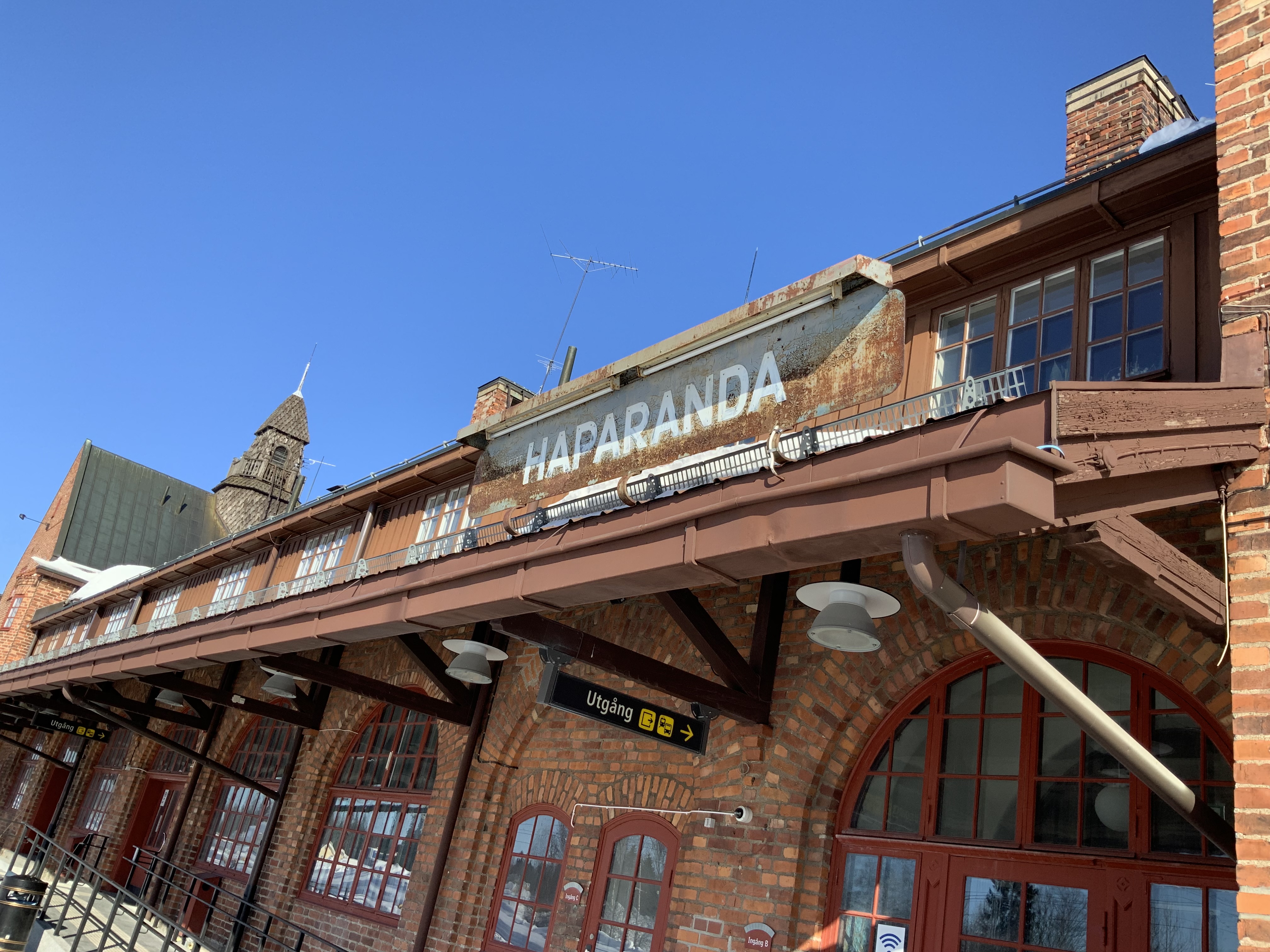
Haparanda station from the platform.

This enormous building is rather ghostly. It is open and (mercifully) heated, but there's no one around. The ghostliness is accentuated by artistically-placed piles of early-twentieth-century luggage. Apparently the border here saw many refugees pass through during the wars. The station was recently and grandiosely renovated using EU money, but doesn't seem to see much use: there's a space for a café, but no café (alas). It's de facto the end of the line, and there are only two trains a day. I check my watch: the next one isn't for four hours. I remember that I've entered a new time zone, change the time on my watch, and check it again. Five hours.

Spectral luggage.

“One-horse town” would be an overstatement for Haparanda. (The Western allusion is appropriate, though: the whole area feels very frontier, the Wild North.) I head into town and find a simple restaurant offering a nice buffet with fresh catch. Although it's modern, the vaulted ceiling and long lines of tables put me in mind of a mead-hall of legend. Perhaps I've been reading too much Kalevala.

In the end, the train is replaced by a bus, a fact about which no one seems very surprised. Two hours later and I'm in the northern Swedish railway-junction town of Boden, for which “one-horse town” is a thoroughly appropriate descriptor. Along comes the corrugated-metal night train and I hop on, finding it hard to believe I'll wake up in Stockholm. Compared to the Finnish sleeper, this one is somewhat dated, but I'm in an ensuite, and it's beautifully spacious. (Probably because they put me in a wheelchair-friendly compartment, with alarm buttons everywhere.) 

Swedish sleeper compartment.

After this chilly, adventurous day I sleep the sleep of the righteous in the comfy train, and in the morning I change onto the fast train to Copenhagen, from where I will continue south. None of this was actually part of the plan! But improvisation is fun, when you can afford it.

Here's the outline of the trip so far. This'll probably be my last post from this holiday, since I'll be working on the train tomorrow. Thanks for reading!


Tuesday, April 02, 2024

Troutworthy's Travel Blog: Helsinki

March, and the Easter weekend in particular, isn't the best time to visit Helsinki. Lots of things are under (re)construction – the Sibelius park, the Havis Amanda statue – and other things, like the Seurasaari open air museum, are closed. The occasion for my visit was a gig by Mew, one of the best bands in the world, performing with the Danish Chamber Orchestra, but this too is a bust: they cancelled at short notice. Still, the day I arrive in Helsinki, the sun is shining.

Suomenlinna fortress in the sun.

Devoid of any grand plan, but with a few tips from friends to work with, I roam. The Temppeliaukio church, carved into the rock, is a sublime piece of modern architecture. Nearby, the Arkadia bookshop is well-and-truly lose-yourself-in-able.

Temppeliaukio Church.

Karelian rice pies are not in short supply.

Karelian pies in a hipster café.

Snow still gathers in clumps in the shade here, unlike in Stockholm, and much of the bay is frozen over. With the Sibelius park denied to me, I get a cinnamon bun and coffee at Café Regatta and gawk out over the ice. Later, wandering round town, hopping on and off ancient trams, I do some more gawking at the fine Art Nouveau buildings that seem to be on every corner. The Oodi central library is a bit of a monstrosity from the outside, but on the inside is a fine civic building, a library for the twenty-first century. At the Kiasma contemporary art gallery just round the corner, I'm surprised to see that one of the artists who's being exhibited is Simon Fujiwara, who's featured on this blog before.

On my second and third days in Helsinki, the weather turns cold and grey, and on the afternoon of the fourth it starts to rain quite heavily. This is fine; I'd probably have felt short-changed if I'd visited a Baltic city and there hadn't been at least one day like this. But four days is not enough for Helsinki, and I hope to come back here one day.

Monday, April 01, 2024

Troutworthy's Travel Blog: The Party Boat

The party boat.

Stockholm was in many ways as I remembered it – though, as I realized with a shock, it's been nearly twelve years since my previous visit, and even that was for a conference with little time for sightseeing. This time I found myself at the Hagaparken to the north of the centre. Most of the winter ice is gone, though a cold wind still blows. We stopped for coffee at a mysterious copper tent.

The next day, after some more wandering, we visited the Vasa museum. Not the titular “party boat” of this post, it's a seventeenth-century ship which immediately capsized in Stockholm harbour on its maiden voyage and was preserved in the city's historically-minded Baltic waters. The museum too was as I'd remembered it from my first visit, perhaps unsurprisingly. It's huge, dark and austere and a handy reminder of human hubris and folly. The academics and conservationists now labouring to preserve it seem almost monomaniacal: the constant visits from humans, we are told, take their inevitable toll on the ship's integrity, but they are working to make sure it lasts forever. Perhaps, when the apocalypse has passed and a future race of extraterrestrials stumbles upon the shattered remnants of our sorry planet, the preserved Vasa will still be there to teach its lesson to these new visitors. “Look on my Works, ye Aliens, and despair!” Or perhaps, more likely, it'll be a second-order failure.

The Vasa.

In the afternoon, we boarded the ship to Helsinki.

I must confess to having had the wrong expectations of this journey. For me it was a fairly sober and straightforward way of getting from A to B, and, from my knowledge of the inhabitants of the area, I expected the voyage to be dull, more than anything else. Turns out I didn't know the inhabitants of the area as well as I thought.

My associate sagely described the experience as a cross between Dubai duty free and a Barnsley Travelodge, and it's an apt comparison. Outwardly all is calm, at least for a while: for the first four hours, as the sun slowly sets, the Silja Serenade traverses the Stockholm archipelago, hitching up its skirts to navigate the narrow channels. It's tranquil and beautiful.

Dancing with another passing titan.

Inside, Ragnarok is here. In the time we've been out on deck, the Swedes and Finns have wasted no time, and have already put several away. Children spin each other around on rotating seats as their parents swill lager. On the stage of the Starlight Lounge, a cover “band” mimes along to various 80s classics; when Abba comes on, everyone goes apeshit. And down at the sixth circle of hell – sorry, deck – our Nordic heroes are fortifying themselves with as many twelve-packs and two-litre bottles of whiskey as they can carry. One can see why the Man in Seat 61 describes these voyages as having “a reputation as party boats”.

Bright lights, big boat.

At around midnight we're due to dock at Mariehamn, in the Åland islands. The ship slows down and stops, but the party doesn't. From here it's nearly ten hours across the open sea until we reach our destination, so I retreat to my cabin. The less said about the rest of the journey, the better; suffice it to say that I'm not much more of a fan of boats than I am of flying, and even with the partygoers well out of earshot there's plenty to occupy my mind.

We shuffle off the boat punctually in the morning. On the bright Helsinki harbourside, a group of youths with nothing in the way of luggage lurch endearingly along, likely readying themselves to do the whole thing again in reverse in the afternoon. All power to them.

Thursday, March 28, 2024

Troutworthy's Travel Blog: Heading north for Easter

The sleeper train from Hamburg to Stockholm has only been running since 2022 – part of the new wave of sleepers that have been popping up around Europe since the dark days of the mid-2010s. The nadir was 2014–16, when Germany's Deutsche Bahn got out of the sleeper business entirely. But, aided by a heavy dose of shame, they're making a comeback, especially in Scandinavia.

And so I'm on one, and will be in Stockholm within the hour. That's about 1300km north from Konstanz, which isn't bad for just over 24 hours, the first four of which were spent trundling across the Schwäbische Alb. It hasn't all been plain sailing: the ICE to Hamburg ended up 45 minutes late, and the sleeper set off from Hamburg-Harburg rather than the city centre due to engineering works. At this point the sleeper is over an hour delayed, though in my experience that's not at all out of the ordinary for night trains (unfortunately).

Photo of birch forest out of train window
A representative vista in southern Sweden

The sleeper compartments are narrow, but the beds surprisingly comfortable. The train seems to be completely booked up; my compartment-mate tells me that there's far more demand than supply. Breakfast is a fresh bread roll with some butter, cream cheese and jam; the coffee is less shit than I'm used to on trains. Now that I've woken up, southern Sweden rolls by unremarkably, mostly birch or pine forests on level ground punctuated by serene patches of water. The sun is shining.

Sunday, October 27, 2019

Where can I get to in 12 hours from Konstanz without flying?

The Scientists4Future at the HU Berlin have launched a project to eschew short-haul flights, provided that the journey can instead be completed within 12 hours by rail. This blog post gives an overview of some of the places you can get to this way. (Hopefully, a few of them will SHOCK you!)

The Deutsche Bahn website was used to calculate all the below journey options, with 28th Oct 2019 as the (fairly arbitrarily chosen) notional day of travel.

So, what are your options...?

1. Anywhere in Germany

Okay, this is a slight exaggeration. The shortest time I can see to get to Westerland, on the island of Sylt, is 12:25. And Ostseebad Binz, on the island of Rügen, takes at least 12:59, with the quickest route to Stralsund coming in at 12:06. Hopefully you won't begrudge me the extra few minutes, though, especially since none of these are particularly common destinations for academic business trips.

Hamburg, on the other hand, can be done in 8:13 with only one change. Berlin can be done in 8:36, and Köln in a mere 5:01. This may not be particularly surprising to anyone, though, so let's move on.

2. Anywhere in Austria, Belgium, Liechtenstein, Luxembourg, Monaco, or Switzerland

Austria is not as long as it looks. Graz can be got to in just over 10 hours, Klagenfurt in just over 9, Vienna in less than 9. The longest trip I've been able to find is to Jennersdorf, on the border with Hungary, and apparently a fairly unremarkable place. Still doable in under 12 hours.

As for Belgium, a trip to De Panne, on the North Sea coast near the French border, will be over in the blink of an eye (9:59). The pretty little town of Couvin, at the end of a branch line in Wallonia near Namur, will take you 10:26. More usefully, you can reach Brussels within seven hours.

Liechtenstein is obvious, as is Luxembourg (just over 6 hours). Almost everywhere in Switzerland is accessible within 5 hours; if you want to train it to Brusio with its spiral viaduct, high in the Alps on the Bernina railway, you'd better leave 6:20.

The Brusio spiral viaduct (CC-BY 3.0, by Kabelleger)

3. Most places in Czechia or the Netherlands

Ostrava, the Czech town that's the furthest from Konstanz (near the border with Poland), will push you over the limit at 12:20, as will Olomouc at 12:09 (just). But Prague can be reliably got to in a piffling 9:32, and Brno in 10:38. Meanwhile, Amsterdam is a comfortable 8:35, and Groningen or Rotterdam can be reached in under 10. If you want to go right to the North Sea coast on a branch line, brace yourself for a longer journey, though.

4. Denmark, Hungary, Poland, Slovakia, Slovenia

Bratislava is only 10:13, and Ljubljana a mere 10:24! As for Denmark, Hungary and Poland, admittedly, you probably won't get to anywhere useful within these countries in 12 hours. But Budapest, for instance, is only 12:09, Poznan is only 12:16, and places like Aarhus, Copenhagen, Warsaw and Wroclaw are doable as part of a longer day. Zagreb, in Croatia, is only just out of reach at 12:44, and there's also a sleeper that goes there from Zurich.

5. Northern and Central Italy, and almost all of France

At 5:41, Milan is embarrassingly easy to reach. From there you can travel onwards to lots of other major cities within the 12-hour limit: Florence at 7:37, Rimini 8:29, Venice 8:31, Rome 9:14, Trieste 10:30, Naples 10:47. Only the far south and Sicily take longer.

France is astonishingly accessible. With Paris less than five and a half hours away, you can be there in time for a leisurely lunch. Connections via Paris, Dijon and Strasbourg will also get you to places like Lille (7:17), Marseille (7:42), Bordeaux (8:16), Nantes (9:07), Toulouse (11:05), Bayonne (11:07), and even Brest at the very tip of Brittany (an incredible 10:08, if you can leg it across Paris fast enough). You'll only struggle with getting somewhere in France within 12 hours if it's at the far end of a tiny branch line.

If you are a fan of micro-states, Vatican City (via Rome), San Marino (via Rimini) and Monaco (10:15) are all within your grasp. And Barcelona is SO DAMN CLOSE to being under the limit (12:21), putting you not that far from Andorra (okay that's a stretch but work with me here). Another Spanish destination that's easily doable within a day is Irun, in the Basque country, at a fairly comfortable 12:36. And if you stay on that last train you'll end up in Lisbon in the morning.

6. The UK

London is reachable in 8:59 by Eurostar via Paris, if the patron saint of connections extends his blessing to you. More usually it'll be about 10 (you need to hang around a bit in Paris). The Eurostar will also allow you to travel on to Cambridge (10:23), Oxford (11:04), Birmingham (11:17), York (11:29), Sheffield (11:55), and even Manchester (11:56), just. Within a slightly longer day you can also get to the capitals of Wales (Cardiff, 12:36) and Scotland (Edinburgh, 14:22), as well as Leeds (12:07), Newcastle (12:44) or Lancaster (12:46).

So that's not a bad range of places for half the time it takes for the Earth to rotate on its axis. Here's a map giving an overview:


With options like this, why would you fly short-haul to any of these places?